How to fix facial asymmetry: what really works
How to fix facial asymmetry: what styling, treatments and braces can change, why exercises fall short, and when uneven features need a doctor.

How to fix facial asymmetry depends on what is causing it. A mild difference between your two sides is normal and needs no treatment, a photo or a habit can exaggerate it, and only a difference in your bite or bones calls for a dentist or surgeon. This guide helps you work out which one you have, what each option can realistically change, and which popular fixes have no evidence behind them.
Is facial asymmetry normal?
Yes. Facial asymmetry means the left and right sides of your face do not mirror each other exactly, and that describes nearly everyone. One eye sits slightly lower, one brow arches higher, the nose leans a touch or the jaw is fuller on one side. Imaging studies find measurable differences in more than half of the people examined, and many of those people never noticed.
A face not symmetrical is not a faulty face. You notice yours more than anyone else does for two reasons: you study it up close, and you know it from the mirror, which flips it left to right. In a photo, the same small difference lands on the side you don't expect, so it looks wrong to you and ordinary to everyone else.
Why is my face asymmetrical?
Working out how to fix facial asymmetry starts with the cause. What causes facial asymmetry usually comes down to one of six things, most of them long-term, and several can act at once.
| Cause | What it does, and where to start |
|---|---|
| Growth and genes | The two sides develop slightly differently, so the difference has always been there. Usually nothing needs doing. |
| Age and sun | Skin and volume change unevenly, and the side that gets more sun can show it sooner. Start with sun protection, then styling or fillers. |
| Teeth and bite | Lost teeth, dental work or a crossbite change how the jaw and lower face sit. See a dentist or orthodontist. |
| Injury | An old break in the nose, cheek or jaw can heal slightly out of line. See a surgeon if it bothers you. |
| Nerve or muscle | Bell's palsy, a stroke or a tight neck muscle can weaken or pull one side. See a doctor promptly. |
| Daily habits | Smoking, sleeping on one side or chewing on one side may add small differences. Change the habit, but expect little. |
Can sleeping on one side of your face cause asymmetry?
Possibly a little, but nobody has shown that it reshapes a face. Small studies link sleeping on one side or on your stomach with slight differences, and they cannot prove which came first. So can sleeping on one side cause facial asymmetry? Steady pressure may deepen the creases on that cheek over the years. Switching sides costs nothing, but don't expect to see it in the mirror.
Does eating on one side cause facial asymmetry?
It may build up the chewing muscle on that side a little, because the masseter, the large muscle at the back of your jaw, grows with use. The more useful question is why you favour one side. Pain, a missing tooth or a bite problem is a common reason, and a dentist can check all three.
Check what you are working with first
Before you change anything, rule out the photo. A slightly turned head, light from one side or a selfie lens held close can make a balanced face look lopsided, and that is the cheapest problem to solve.
Take a fair photo. Face the lens squarely at eye level in even light, with your hair back and your glasses off. The photo rules cover the details.
Measure it. Run the free symmetry test. It compares 22 pairs of points across a midline fitted to your face and scores your eyes, brows, nose, mouth and jaw.
Find the largest gap. Your result names the feature with the largest difference. If it is your eyes, the canthal tilt calculator compares the angle of each one.
Retake before you trust it. Repeat with a second photo. A difference that shows up in both is worth acting on, and one that vanishes came from the camera.
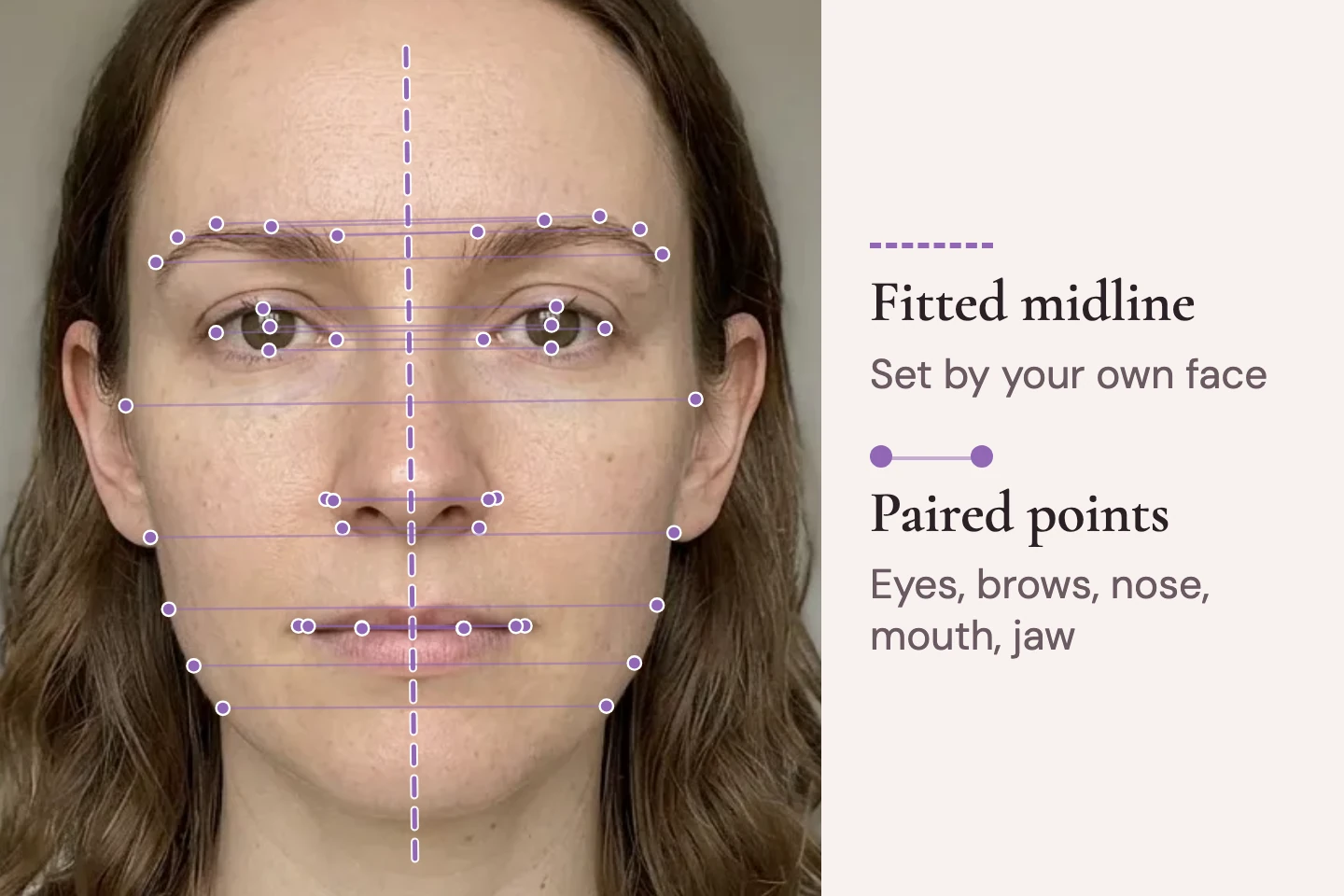
The test shows where your two sides differ, never why. A low jaw score cannot tell a bite problem from a shadow, and it says nothing about your health. It is not a verdict on your looks either: our guide to what a face rating really measures explains why.
How to fix facial asymmetry by cause
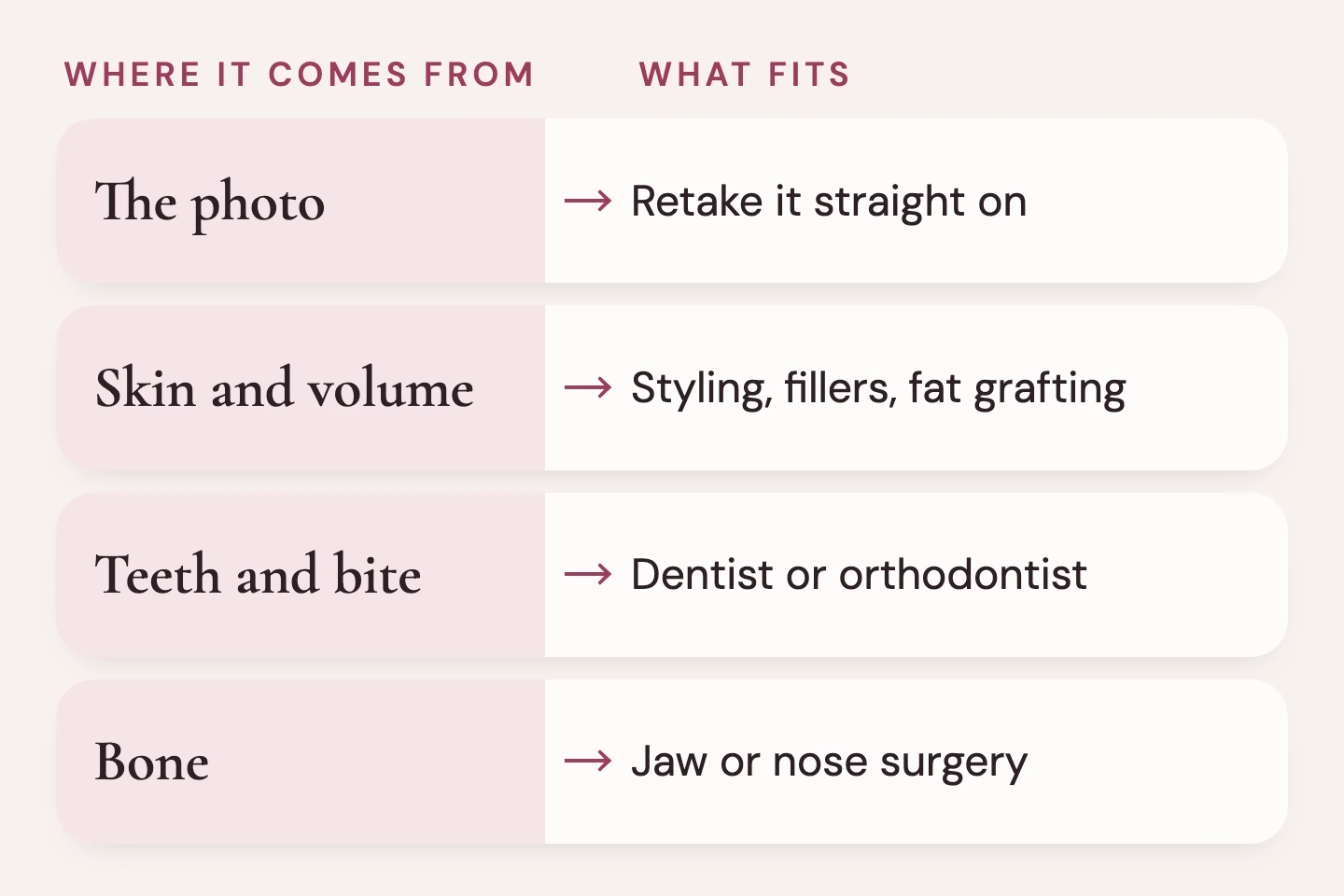
The right fix depends on what you found. Makeup won't solve a bite problem, and surgery won't solve a shadow, so start with the least you can do and stop as soon as you are happy.
How to fix an asymmetrical face with styling
Most searches for how to fix asymmetrical face features can end here, because small differences respond well to styling and it carries almost no risk.
- Brows. Shape a higher or thinner brow to match its partner. Brows frame the eyes, so this is the quickest visible change.
- Hair. A side part or soft layers can draw the eye away from a fuller cheek. Try the part on each side and keep the one you prefer.
- Makeup. Blush and contour can even out your cheeks, and liner can balance an eye that looks smaller.
- Glasses. Have your frames adjusted to sit level, since crooked frames make a small height difference show.
Non-surgical treatments
When the difference is in soft tissue, a clinician can often even it out without surgery. Ask about the risks of each option, and choose someone qualified to treat faces.
- Dermal fillers add volume to the flatter side of the cheek, chin or jaw. The change is immediate, but it wears off and needs repeating.
- Fat grafting moves your own fat to a flatter area. It is a minor procedure, and some of the fat is usually reabsorbed.
- Botulinum toxin (Botox) relaxes a stronger muscle, such as a masseter that is bulkier on one side. It wears off after a few months.
Can braces fix an asymmetrical face?
Sometimes, if the cause is in your teeth. So can braces fix an asymmetrical face? Braces or aligners move teeth and can correct a crossbite or a shifted midline, which can even out the lower face. They do not reshape adult jawbones, so a difference in the bone needs another plan, often braces combined with jaw surgery. An orthodontist can tell you which applies, usually with x-rays or a scan.
Facial asymmetry surgery
Surgery is the option for differences in the bone itself. Jaw surgery repositions the upper or lower jaw, chin surgery or an implant corrects an off-centre chin, and rhinoplasty straightens a nose that leans. It can make a large change, and it comes with real recovery time and risk. That makes it a medical decision for a qualified surgeon after a full assessment, never a response to a score.
How to fix facial asymmetry naturally
At home, you can change your habits and how your face reads, not your bone structure. Anyone searching how to fix facial asymmetry naturally at home should expect modest results, and the same goes for how to fix asymmetrical face naturally with a tool or a routine. Most videos on how to fix face asymmetry promise more than the evidence supports.
| Home method | What it can do, and the evidence |
|---|---|
| Facial exercises | May tone muscles, but cannot move bone. No clinical research shows they make a face more even. |
| Mewing | A tongue posture trend with no shown effect on adult bones. It is not supported by good research. |
| Gua sha and massage | Can ease tension and puffiness for a while, with no sign of lasting change. |
| Changing sleep side | May reduce pressure creases on one cheek. The evidence is limited. |
| Chewing on both sides | Shares the work between both jaw muscles. The evidence is limited, so check your teeth first. |
| Sunscreen, no smoking | Slows uneven skin ageing, and this one is well supported. |
If you have looked up how to use gua sha for asymmetrical face concerns, treat it as relaxation rather than a fix. Facial physical therapy is a different matter: after Bell's palsy or a nerve injury, a specialist can help retrain weakened muscles, and that belongs with your doctor.
When to see a professional
Deciding how to fix facial asymmetry is much easier with a diagnosis, especially for a very asymmetrical face or a difference that has changed recently. Here is who to ask:
- Emergency care or a doctor: sudden drooping, numbness or weakness, or any new change you cannot explain.
- A dentist or orthodontist: jaw pain, clicking, trouble chewing or teeth that meet unevenly.
- A facial plastic or maxillofacial surgeon: a difference in the bone, or a leaning nose that blocks your breathing.
- A doctor or therapist: thoughts about your face that take up much of your day or keep you from going out. That distress is real and treatable, and a score or a procedure rarely settles it.
Facial asymmetry FAQ
Can facial asymmetry be fixed?
It depends on the cause. Mild differences can be softened with styling, soft tissue differences evened out with fillers or fat grafting, bite problems treated with orthodontics and bone differences corrected with surgery. Perfect symmetry is not a realistic goal, and most people need no treatment at all.
Can facial asymmetry go away?
Rarely by itself, if it comes from growth or bone. Asymmetry from Bell's palsy or swelling often improves as the condition settles, and a difference caused by the camera vanishes with a better photo. A long-standing difference usually stays about the same unless something treats it.
Does facial asymmetry get worse with age?
It can become a little more visible. Skin loosens and volume changes unevenly over the years, one side may get more sun, and lost teeth can change the lower face. Sun protection, not smoking and regular dental care are the most useful habits.
Can an asymmetrical face be attractive?
Yes. An attractive asymmetrical face is common, and many admired faces are visibly uneven. Studies find only a small link between symmetry and attractiveness ratings, and a slight difference between the sides often reads as character. A perfectly mirrored face can look strange rather than better.
Do people notice facial asymmetry?
Usually far less than you do. Other people see your face moving, from a distance and as a whole, while you study it still and up close. Research also suggests many adults with measurable asymmetry never notice it, and many who do are not bothered by it.
How much does it cost to fix an asymmetrical face?
There is no single price. Styling costs little, fillers are paid per session and need repeating, and orthodontics runs over months or years. Facial asymmetry surgery cost varies widely by procedure, surgeon and country, and insurance may only help when function is affected. Ask for a written quote after an assessment.
Is 90% facial symmetry rare?
There is no reliable figure, because every tool measures symmetry differently and none of them samples the population. On the FaceStats test, 90 and above is the closest of four bands, and nobody scores 100. It describes one photo, and a score from another tool is not comparable.
Start with one fair photo
You cannot choose a fix until you know what you are fixing, so remember that how to fix facial asymmetry starts with measuring it. Take one straight-on photo and the free FaceStats test gives you a 0–100 score, a score for each feature and a mirror view, on your device with no sign-up. If you want your symmetry read with the rest of your face, the sample report shows what the full report covers.