Free · no sign-up
Face Symmetry Test: Is My Face Symmetrical?
Upload a front-facing photo and this free face symmetry test compares the left and right sides of your face across 22 landmark pairs. You get a 0–100 symmetry score, a score for your eyes, brows, nose, mouth and jaw, the midline drawn on your picture and a mirror view, all in seconds.
- 22 landmark pairs
- Five feature scores
- Photo stays on your device
- Mirror view included
Drop a front-facing photo
JPG, PNG, WebP or HEIC up to 30 MB. One face, straight on, even light.
Runs in your browser. The photo is not uploaded.
How it works
How the Face Symmetry Test Works
By hand, you would fold a printed photo down the middle and compare the halves. The face symmetry test does the same with measured points, using a midline fitted to your own face and not the centre of the picture.
Add a Front-Facing Photo
Drop in a selfie, paste a picture or use your camera. A quality check asks for another photo when the face is blurred, turned too far or too small.
A Midline Fitted to Your Face
A face model places 478 landmarks in your browser. Nine points from forehead to chin set the midline, so a leaning head or a face off-centre in the frame does not count as asymmetry.
Both Sides Compared, Pair by Pair
Every right-side point is mirrored across that line and compared with its left-side partner. The gaps become five feature scores and one overall score, with a mirror view below.
What it measures
What the Face Symmetry Test Measures
Matching points, grouped by feature and scored by one rule. This face symmetry analysis rests on distances on your photo, so you can check each result against its lines.
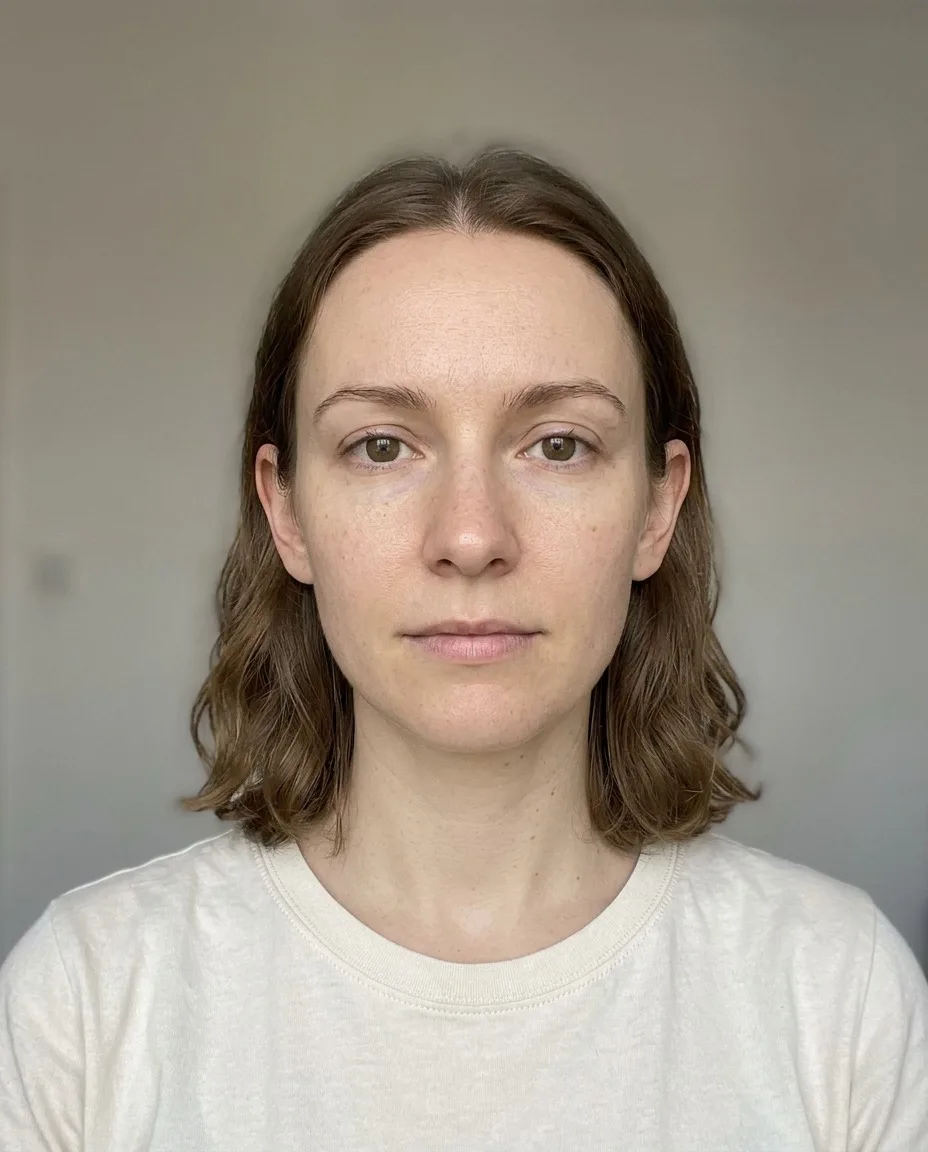
Fitted Midline
A straight line fitted through nine landmarks down the centre of your face, from forehead to chin. It is the axis of symmetry, drawn dashed on your photo.
Paired Landmarks
Five pairs for the eyes, five for the brows, three for the nose, four for the mouth and five for the jaw: 22 in all, picked from 478 landmarks.
Five Feature Scores
Eyes, brows, nose, mouth and jaw each get their own 0–100 score. Your result names the feature with the largest difference.
Gap as a Share of Face Width
The average gap between each mirrored point and its partner is divided by your face width at the cheekbones, so photo size does not matter. Every 1% takes off 5 points.
Overall Symmetry Score
The five features are combined by weight: jaw 35%, eyes 25%, brows 15%, mouth 15% and nose 10%. This is the headline number of your result.
The Symmetry Mirror
Your original beside two composites, left × left and right × right, each built from one half of your face. They are a demonstration, not two real faces, and you can save them to your device.
Your result
Symmetrical Face Scores: What Each Band Means
Your overall score falls into one of four bands. The cut-offs are this test's own convention for describing the gap between your two sides, not a clinical norm and not a ranking against other people.
0–69
Larger Difference
The two sides measure further apart. A turned head or side light can cause this by itself, so retake the photo straight on before reading more into it.
70–79
Moderate Match
One feature is noticeably offset. Tap each feature to see which pairs pull the score down, and check that your expression was relaxed.
80–89
Close Match
The average gap is only a few percent of your face width. Small differences like these are a normal part of a real face.
90–100
Very Close Match
Paired points sit within about 2% of your face width of each other. It is the closest band here, though nobody reaches 100 and it describes one photo.
Is a higher score better? Only in the narrow sense of a closer geometric match. The bands describe one photo, and a higher band says nothing about your looks or your worth.
Accuracy and limits
How Accurate Is a Facial Symmetry Test?
A facial symmetry test is accurate at one job: measuring the gaps between paired points in your photo, the same way every time. How the picture was taken can still move the score.
Same Photo, Same Score
What it measures well
The same photo always returns the same scores. The result comes from geometry, not a model's opinion, so nothing drifts between runs.
What it can't tell you
One fixed number across different photos. Two careful pictures of the same face can differ by a few points, and that is ordinary.
Head Lean and Head Turn
What it measures well
A head leaning to one side is corrected, because points are mirrored across a line fitted to your face and not the frame of the photo.
What it can't tell you
A turned head is not corrected. One side of the face moves away from the camera, and a small turn can lower the score before any warning appears.
Landmarks and Lighting
What it measures well
Twenty-two pairs read from 478 landmarks on your own device, with the most weight on the jaw and eyes.
What it can't tell you
Points are estimated where hair, a beard or shadow covers them, and side light can shift a point on one side only.
What the Score Means
What it measures well
A plain geometric fact about one photo: how closely your left and right sides match across a fitted line.
What it can't tell you
Whether you are attractive, or anything medical. This face symmetry test is not a clinical exam, so see a doctor about any sudden change in your face.
No warning does not mean your head was straight. If a score looks low, retake the photo facing the lens squarely before you compare results.
Photo tips
Photo Tips for a Fair Symmetry Score
The face symmetry test measures the picture, so the picture decides the score. Six habits keep both halves of your face equally visible and make two results fair to compare.
Camera at Eye Level
Hold the phone level with your eyes, an arm and a half away. Close up, the lens stretches whatever sits nearest it.
Face the Lens Squarely
Keep your nose centred and both ears equally visible. This matters most for symmetry: a turn moves the far side of your face, and every pair drifts with it.
Even Light on Both Sides
Face a window so each side gets the same light. A shadow down one cheek can shift the points on that side.
Neutral Face, Mouth Closed
A smile is rarely even, and a raised brow moves one side only. Relax your face and close your lips, so you measure your features and not a passing expression.
Glasses Off, Hair Back
Frames can cover the eye corners, and hair can hide a brow or the jawline on one side only. Take your glasses off and tuck your hair behind your ears.
Sharp, With No Filters
Rest the phone or use a timer so edges stay crisp. Turn off beauty mode too: filters reshape the face and can smooth away the differences you came to measure.
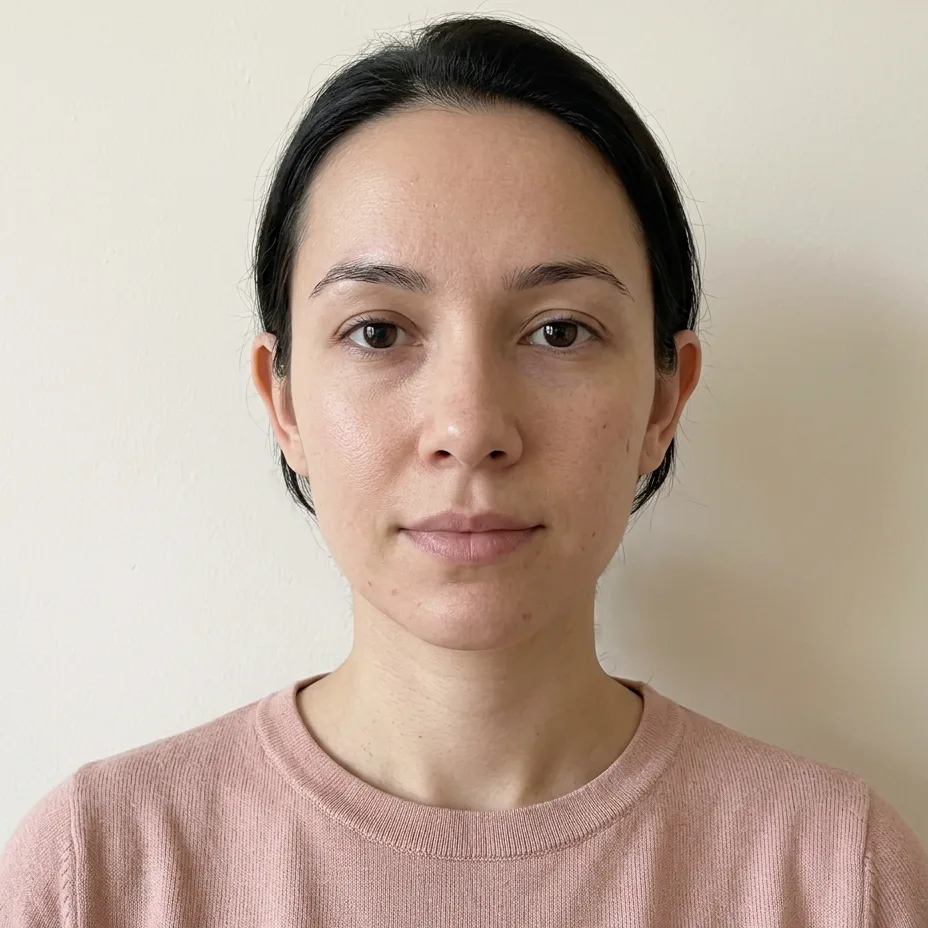
Changing the look
How to Make Your Face More Symmetrical
People search for how to improve face symmetry or "how to make face more symmetrical", hoping for an exercise. The honest answer: bone structure does not change with routines. What you can change is how the two sides read.
Start With the Photo
Retake the picture straight on, in even light, before you decide anything. A turned head or a shadow can lower a score by itself.
Try Your Part on Both Sides
A side part or soft fringe can draw the eye from a higher brow or fuller cheek. Try each side and keep the one you prefer.
Balance Brows and Makeup
Shaping a higher or thinner brow to match its partner is the quickest visible change. Liner, blush and contour can even out small differences.
Have Your Frames Fitted
Glasses add a straight line across the face, so frames that sit crooked make a small height difference show. Have them adjusted so they sit level.
Relax Your Expression
Many people favour one side when they smile or raise a brow. That is part of your character; for the test, a relaxed face keeps it out of the score.
Retest the Same Way
Use the same spot, light and distance each time, so a change reflects your face and not the camera. Jaw or bite concerns belong with a dentist or doctor.
Your privacy
A Private Face Symmetry Test
This face symmetry test works inside your browser. Your photo is measured on your own phone or computer, so it is never uploaded, stored or used to train a model, and the tool itself saves nothing.
Measured on Your Device
The face model downloads to your browser and runs there. Landmarks, scores and mirror images are all made on your phone or computer.
No Sign-Up
The free test needs no account, no email and no payment. Close the tab and the photo is gone.
Never Used for Training
A photo that is never uploaded cannot be kept, shared or used to train a model.
Uploaded Only for the Full Report
The optional full report uses AI processing in the cloud. Your photo is uploaded only after you choose to buy it and agree, and you can delete it afterwards.
Full Report for Adults
The paid report is for people aged 18 and over using a photo of themselves. The free test asks for no personal details.
Your Card, Your Choice
The result card and the mirror images are drawn in your browser too. You decide what to save or share, and whether the card shows your photo.
Common questions
Face Symmetry Test FAQ
Short answers on what the score means, why a photo changes it and what symmetry can and cannot tell you about your face.
More tools
More Free Face Tools
Each one looks closely at another part of your face, such as its shape, its proportions or your eye angle, free and in your browser.
Guides
Guides to Facial Symmetry
Longer reads on what the score means and how to photograph your face fairly, each one leading back to this test.
Try the Free Face Symmetry Test
Upload one photo to check face symmetry feature by feature, with the midline drawn on your own picture and a mirror view below it. Free and private, with no sign-up.