Free · no sign-up
Face Shape Calculator: What Is My Face Shape?
Upload a front-facing photo or type in four measurements, and this free face shape calculator sorts your face into one of seven shapes. See how closely you fit it and the next closest, with the lines drawn on your photo: a face shape test and a face shape detector in one.
- Photo or tape measure
- Seven face shapes
- Photo stays on your device
- Results in seconds
Drop a front-facing photo
JPG, PNG, WebP or HEIC up to 30 MB. One face, straight on, even light.
Runs in your browser. The photo is not uploaded.
How it works
How to Find Your Face Shape
Wondering how to find my face shape without tracing a mirror? The face shape calculator takes four lengths from your photo or your tape measure, turns them into ratios and finds the closest of seven shapes.
Add a Photo or Four Numbers
Drop in a selfie, paste one or use your camera. No photo to hand? Open Enter measurements and type four numbers in centimetres or inches.
Four Lines, Read for You
From a photo, the face shape analyzer places 478 facial landmarks in your browser, levels your head and reads forehead width, cheekbone width, jaw width and face length.
Your Shape, With Its Fit
Both routes compare you with the same seven shapes. You see your shape, a fit percentage and a short styling note, plus the next closest shape when your ratios sit between two.
What it measures
How to Measure Face Shape: Four Lengths, Three Ratios
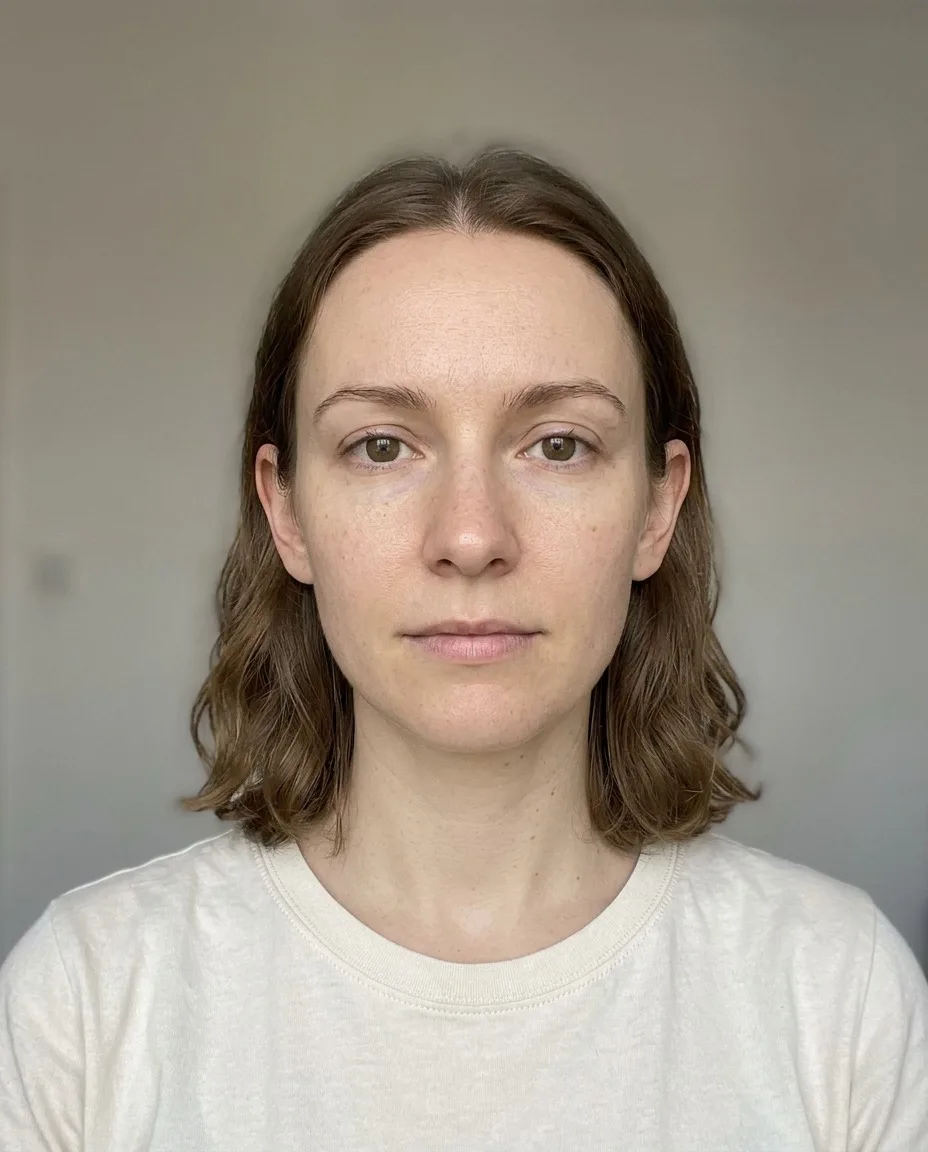
Any face shape finder depends on the same four lengths. Take them with a soft tape measure at a mirror, or let the photo mode read them. The ratios between them decide your shape.
Face Length
Hairline to chin, straight down the middle of your face. In a photo, the hairline is estimated from the top of the forehead.
Forehead Width
Across the forehead at its widest, just above the brows. Keep the tape level and your hair back.
Cheekbone Width
The widest line across your cheekbones, from one outer edge to the other. Photo results count this length as 100 and show the other three against it.
Jaw Width
Across the angle of the jaw, from one corner to the other. A photo also reads how sharply the jaw turns there, while typed numbers carry the width alone.
Three Ratios
Length, forehead and jaw, each divided by the cheekbone width. Ratios ignore units, so centimetres and inches give the same answer.
Fit Percentage
How close your ratios sit to your shape's reference. It is a similarity, not a probability, and a lower fit puts you nearer another shape.
Face shape chart
Seven Face Shapes and Their Typical Proportions
This face shape chart lists the different face shapes the calculator can return, with the typical tape-measured proportions of each and the cheekbones counted as 1. Your shape is the one your ratios sit closest to. These references are a styling convention, not a medical standard, and no shape is the one to aim for.
Oval Face Shape
The middle of the chart: length about 1.32 times the cheekbones, forehead 0.95 and jaw 0.88 of their width. A face where no width or length stands out lands here.
Round Face Shape
Shorter than average, about 1.20 times the cheekbones, with forehead 0.95 and jaw 0.87. From a photo, a softly curved jaw corner also leans a face round.
Square Face Shape
About as short as round, at 1.24 times the cheekbones, but with a wide jaw near 0.96 and forehead near 0.94. From a photo, a sharper jaw corner also leans a face square.
Heart Face Shape
A wide forehead near 1.01 times the cheekbones over a narrow jaw near 0.81, with length about 1.33. Some charts call this an inverted triangle.
Diamond Face Shape
The cheekbones stand out: forehead near 0.90 and jaw near 0.81 of their width, with length about 1.33.
Oblong Face Shape
Clearly longer than wide, about 1.48 times the cheekbones, with average widths. Some charts split this into oblong and rectangle; this tool does not.
Triangle Face Shape
The jaw is the wide end: jaw near 0.96 and forehead near 0.88 of the cheekbone width, length about 1.24. Some charts call this a pear shape, the reverse of a heart.
Between Two Shapes
Many faces sit between two of these. Your result then names the next closest shape with its own fit, and the shape it names always fits best.
Is one shape better? No. A shape describes proportions so you can choose a cut or a frame. The calculator ranks no shape above another, and these ratios do not measure attractiveness.
Accuracy and limits
How Accurate Is a Face Shape Calculator?
A face shape calculator is only as accurate as the four numbers it receives. The references never change, but a photo or a tape adds small errors, and a face between two shapes can land on the neighbouring one.
Same Numbers, Same Shape
What it does well
The same photo or the same four numbers always return the same shape and fit. Fixed references decide, so no opinion drifts between runs.
What it can't tell you
One answer across every photo. Two careful pictures can differ slightly, which matters most when you sit between two shapes.
Photo or Tape Measure
What it does well
A photo saves you the tape, and a leaning head is levelled first. Typed numbers skip the camera, so its angle plays no part.
What it can't tell you
An exact hairline from a photo: it is estimated from the top of the forehead. With a tape, a curved or slanted reading shifts the ratios too.
Widths, Not Contours
What it does well
Four lengths and their ratios, which is what it takes to determine face shape as most charts describe it: length against width, and which end is wider.
What it can't tell you
Chin shape, cheek fullness or how soft your features look. Typed numbers also miss the jaw corner, which only a photo reads.
What the Shape Means
What it does well
A plain description of your proportions, useful when you choose haircuts, glasses and necklines.
What it can't tell you
Whether your face is attractive, or anything medical. This face shape analysis is a styling aid, not a clinical measurement.
We publish no accuracy percentage, because no validated study stands behind one. If two photos disagree, take a third at eye level or check it with a tape.
Photo tips
Photo Tips for a Reliable Face Shape
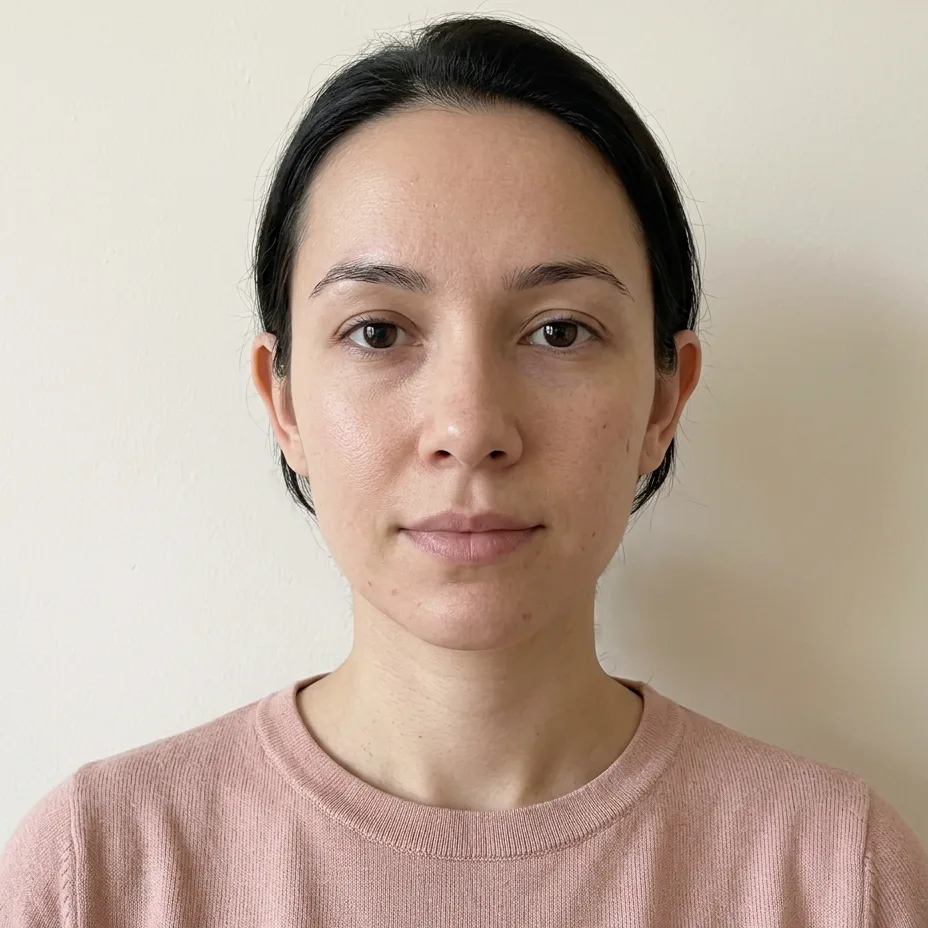
From a photo, the face shape calculator measures what the camera sees, so the picture decides the ratios. Six habits keep your hairline, cheekbones and jaw in view.
Camera at Eye Level
Hold the phone level with your eyes, an arm and a half away. Held higher, it shrinks the jaw and stretches the forehead; held lower, the reverse.
Face the Lens Squarely
Keep your nose centred and both ears equally visible. A turned head hides part of one side, so every width reads narrower.
Soft Light From the Front
Face a window. Side light makes one half of the face look narrower, and overhead light leaves shadows along the jaw and cheekbones.
Neutral Face, Mouth Closed
A smile lifts the cheeks and an open mouth adds length, so relax your face and keep your lips together.
Hair Back, Glasses Off
Hair over the forehead or temples hides the width that separates a heart from an oval. Tuck it behind your ears and take your glasses off.
Sharp, With No Filters
Rest the phone or use a timer so the edges stay crisp, and turn off beauty mode: filters move the landmarks.
Using your result
What to Do With Your Face Shape
There is nothing to fix, and no shape is a goal. Your result helps most at the hairdresser and the optician, where the aim is balance.
Pick a Haircut
Add height on a round face, width on an oblong one and soft layers around a square jaw. Your result ends with a short styling note for your shape.
Choose Your Frames
Picking glasses for face shape comes down to contrast: angular frames on a round face, softer curves on a square one, and frames no wider than your face.
Place Blush and Contour
Makeup follows the same idea: a little shade where the face is widest, a little light where you want more length or width.
Try Necklines and Collars
A V-neck draws the eye down on a round or square face; crew necks add width to an oblong one.
Know Your Angles
Turning a little or lifting your chin changes which width the camera sees. Use that in everyday pictures, and stay straight-on when you measure.
See It on Your Own Face
The optional full report takes your shape and a few short answers, then shows six hairstyle previews on your photo, with frames and a 12-season palette.
Your privacy
Your Photo Never Leaves Your Device
This face shape detector online works inside your browser. Your photo is measured on your own phone or computer, so it is never uploaded, stored or used to train a model.
Measured on Your Device
The face model downloads to your browser and runs there. Your photo stays on your phone or computer from start to finish.
No Sign-Up
Finding your shape needs no account, no email and no payment. Close the tab and the photo is gone.
Never Used for Training
A photo that is never uploaded cannot be kept or used to train a model.
Uploaded Only for the Full Report
The optional full report uses AI processing in the cloud. Your photo is uploaded only after you choose to buy it and agree, and you can delete it afterwards.
Full Report for Adults
The paid report is for people aged 18 and over using a photo of themselves. The free tool asks for no personal details.
Typed Numbers Stay Here
Measurements you type are worked out in the page itself, never sent or saved.
Common questions
Face Shape Calculator FAQ
Short answers on how the tool works, how to measure your face and what a result can and cannot tell you.
More tools
More Free Face Tools
Each one looks closely at one part of your face, such as its symmetry, your eyes or your midface, free and in your browser.
Guides
Guides to Your Face Shape
Longer reads on the shapes and what to do with yours, each one leading back to the face shape calculator.
Square face shape: how to tell and what suits it
A square face shape has even forehead and jaw widths and a short length. See how to measure yours, tell it from round, and pick hair, glasses and makeup.
Oblong face shape: how to tell and what suits it
An oblong face shape is clearly longer than wide. See the ratio that defines it, how it differs from oval, and which hairstyles and glasses suit it.
Triangle face shape: how to spot and style it
Triangle face shape guide: how to measure a jaw wider than your forehead, tell it from pear and heart, and pick hairstyles and glasses that suit it.
Diamond face shape: how to tell and style it
A diamond face shape has cheekbones wider than its forehead and jaw. Learn to measure it, tell it from heart or oval, and pick cuts and frames that suit it.
Heart shaped face: how to tell if you have one
Learn what a heart shaped face looks like, how to measure yours, how it differs from oval and diamond, and which haircuts and glasses suit it best.
Round face shape: how to tell if you have one
What makes a round face shape? Measure your length against your cheekbones, tell round from oval and square, and see which hair and glasses suit it.
Face shape and hairstyle guide
What the four face widths say about your shape, and the haircut direction that balances each of the seven shapes.
Find Your Face Shape in Seconds
Upload one photo or type four numbers, and the face shape calculator names your shape and shows how closely you fit it. Free and private, with no sign-up.