Round face shape: how to tell if you have one
What makes a round face shape? Measure your length against your cheekbones, tell round from oval and square, and see which hair and glasses suit it.
You have a round face shape when your face is almost as long as it is wide, your cheekbones are the widest part, and your jaw curves instead of turning at a corner. One simple measurement settles most doubts. This guide shows you how to take it, how to tell round from oval and square, why your result can shift between photos, and which hair, glasses and brows work with the shape. None of this is a fix, because there is nothing to fix: it is a set of choices about what you want to bring out.
What is a round face shape?
A round face shape is a set of proportions, not a size. Four traits define it:
- Length close to width. Your face measures only a little longer than it is wide across the cheekbones.
- Cheekbones at the widest point. The forehead and jaw sit slightly narrower, and neither end stands out.
- A soft jawline. The jaw curves from ear to chin with no visible corner.
- A curved hairline. The hairline tends to follow the same arc at the temples.
You may also see it called a circle face shape, which is a comparison, not a target. A perfectly round face is rare, because most faces measure at least a little longer than they are wide.
The shape says nothing about your weight either. It comes mainly from your bones, so slim people have round faces, and fuller faces can measure oval or square.
How to tell if you have a round face
You need a mirror or a straight-on photo, a soft tape measure and two minutes. Tie your hair back, relax your face and keep your mouth closed. Then take four straight lines:
Face length From your hairline to the bottom of your chin.
Cheekbone width Across the widest point of your cheekbones, just below the outer corners of your eyes.
Forehead width Across your forehead at its widest, about halfway between your brows and your hairline.
Jaw width Between the two angles of your jaw, just below your ears.
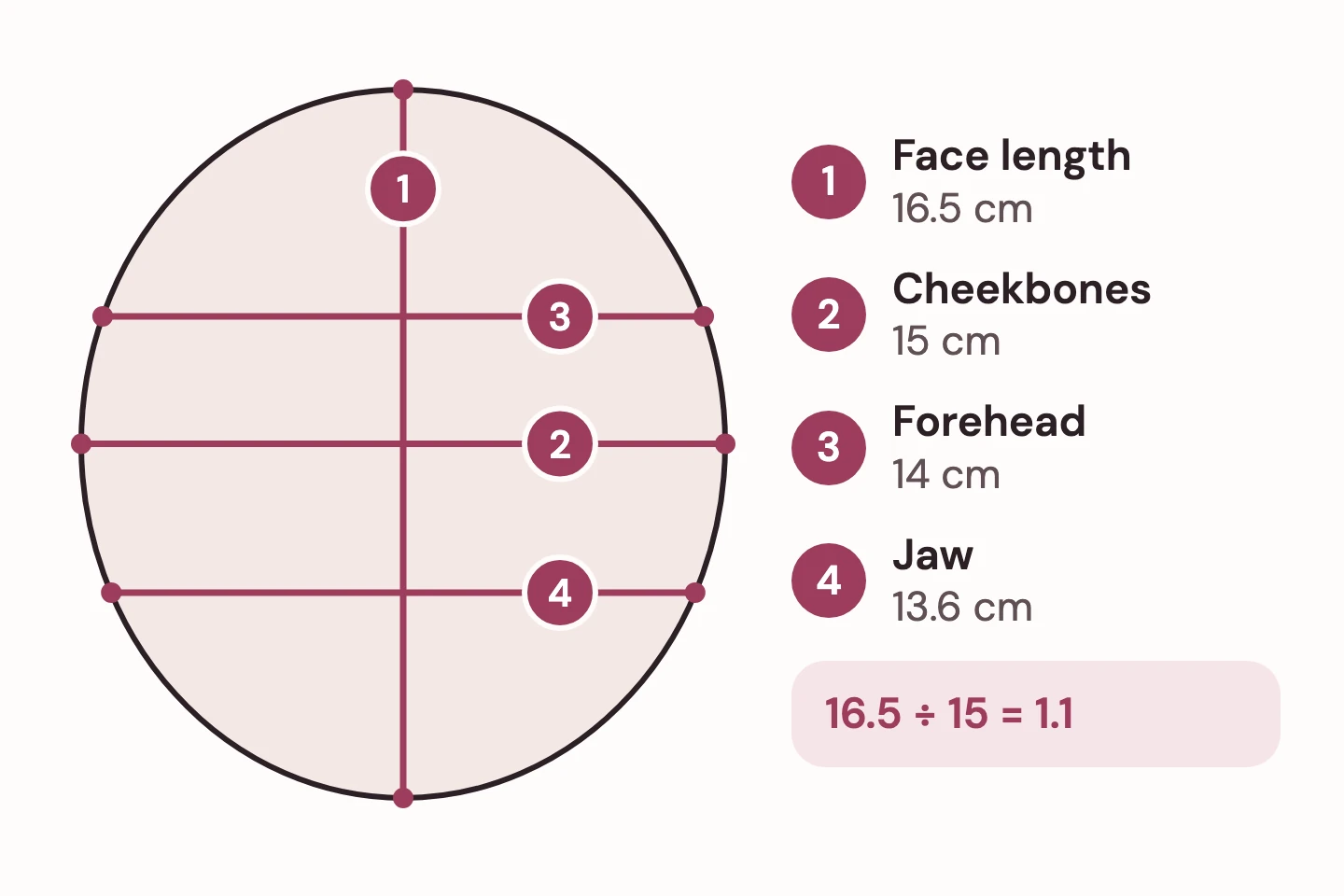
Now divide your face length by your cheekbone width. A typical round face measures about 1.20, against about 1.32 for an average face. Say your face is 16.5 cm long and 15 cm across the cheekbones: 16.5 ÷ 15 = 1.1. With a forehead of 14 cm and a jaw of 13.6 cm, the cheekbones stay widest, and that face reads round.
Our calculator doesn't draw a single line: it compares your ratios with seven typical shapes and names the closest. Other charts use their own cut-offs, because there is no official standard: face shapes are a styling convention, not a medical category. The overall pattern matters more than the second decimal.
Round, oval or square: how to tell them apart
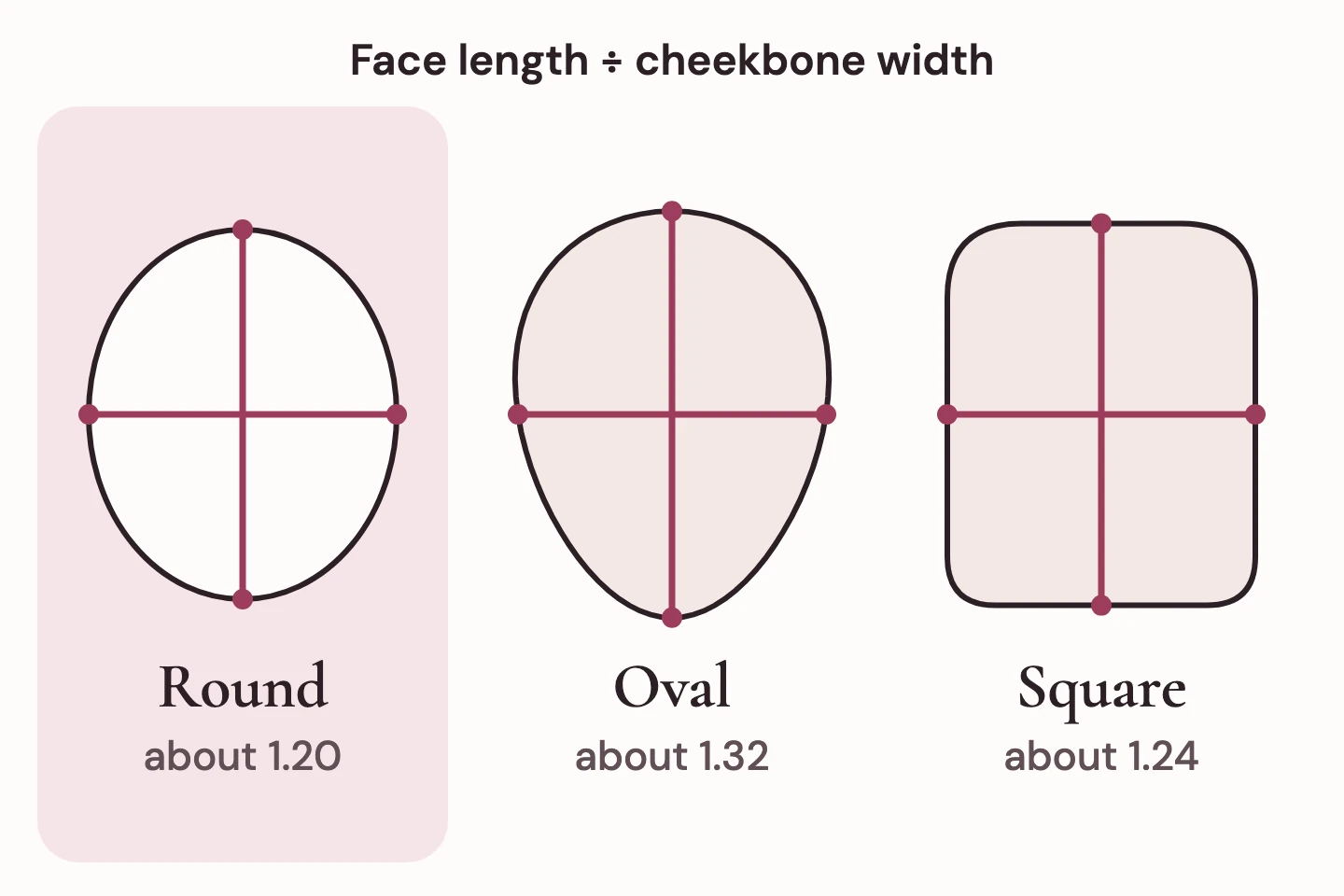
Most doubts come down to two neighbours. Round shares its soft curves with oval and its short length with square. These are the typical readings in our calculator:
| Your reading | What it points to |
|---|---|
| Length about 1.20 times the cheekbones, soft jaw | Round |
| Length about 1.32 times, no width standing out | Oval |
| Length about 1.24 times, with a jaw nearly as wide as the cheekbones | Square |
Round vs oval face
The round vs oval face question is mostly about length. An oval face is clearly longer than it is wide, often close to one and a half times, and it tapers gently towards the chin. A round face stops much sooner.
If you measure between about 1.2 and 1.3, "round or oval face" has no sharp answer. The calculator names the closer shape first and the other as the next closest, and both are fair descriptions. Use the styling ideas they share.
Round vs square face
Both faces are short, so the usual test is the jaw. A square jaw turns at a visible corner below the ear, while a round one keeps curving towards the chin. Run a finger along your jawline in good light and you can usually feel which one you have.
From a photo, the calculator reads that corner too: it measures how sharply the outline turns at the jaw, and a softer turn leans round. Typed numbers can't carry a corner, so with a tape the jaw width decides: a jaw nearly as wide as your cheekbones leans square, and one clearly narrower leans round. Either way, a close call shows the other shape as the next closest, and your own finger gets the last word on that one detail.
Why your result can change between photos
A round face sits between two neighbours, so small errors matter more here than on a long oval face. These are the usual causes:
- Camera height. A phone held above your eyes shrinks the jaw and stretches the forehead. Held below, it does the reverse.
- Camera distance. A front camera held close narrows the face, so keep the phone an arm and a half away.
- Expression. A smile lifts the cheeks, and an open mouth adds length.
- Hair. Hair over your forehead or temples hides the widths that separate one shape from another.
From a photo, the calculator also estimates your hairline from the top of your forehead, so a careful tape reading can differ slightly. Take two or three pictures by our six photo rules before you decide.
Over the years, weight and age change how full your cheeks are, and that can nudge a borderline face towards a neighbouring shape. The bones underneath stay much the same.
Round face shape hairstyles
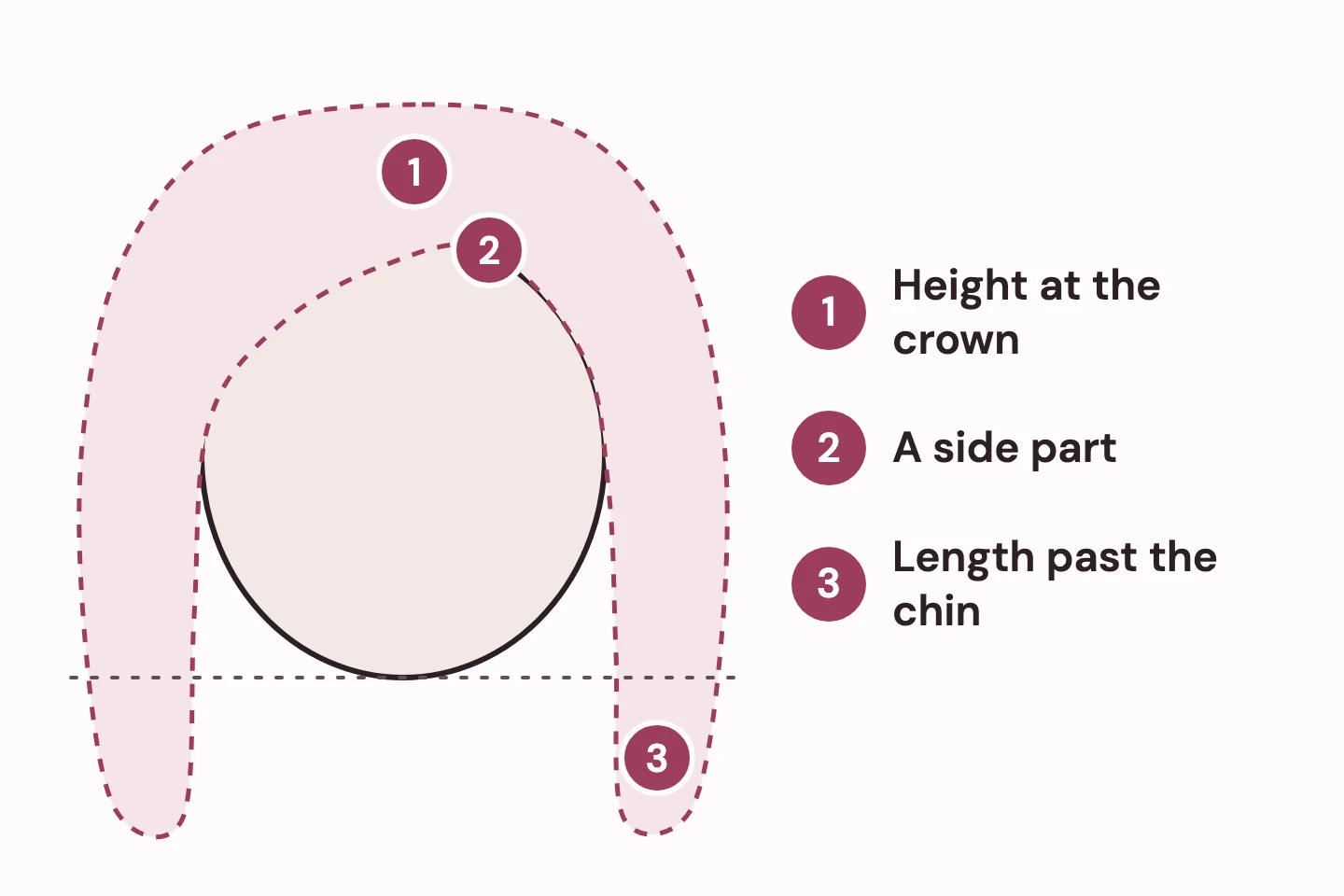
Hair changes what the eye reads as length and width, so it is the quickest way to shift the outline if you want to. Three moves do most of the work: height at the crown, length that falls past the chin, and a line that breaks the circle, such as a side part.
For women
Long layers, soft medium layers and a lob that ends between the chin and the collarbone all add length. A modern shag or a wolf cut lifts the crown, and sleek, straight long hair draws the eye down.
For round face shape bangs, a long side-swept fringe opens the forehead at an angle, while a full, rounded fringe shortens the face. The cut to think twice about is a blunt, chin-length one, because it ends right where your face is widest.
For men
Short sides with volume on top do the same job. A modern quiff adds the most height, and a classic side part or a textured crop adds a clean line without much styling. Bulk at the sides works against you, so ask for a taper.
To compare these moves across all seven shapes, see our face shape and hairstyle guide.
Round face shape glasses
Glasses work by contrast: straight lines give soft curves something to play against. Rectangular, square and geometric frames suit this shape best, and they look balanced when they sit a little wider than your cheekbones. For sunglasses, square styles, wayfarers and angular cat-eyes follow the same logic.
Small round frames are the style to think twice about, since they repeat the curves instead of framing them. That is a guideline, not a ban. If you love a pair, wear them.
Brows and makeup
A soft, lifted arch adds a little height, while a very rounded brow repeats the curve of the face. Don't force a sharp peak, though: the best eyebrow shape still follows your natural brow.
Makeup can use the same idea. Blush swept from the cheekbones up towards the temples draws the eye upwards, and blush placed on the apples of the cheeks brings out their roundness, which many people enjoy. If you contour, keep it soft and just under the cheekbones.
Round face men: what stays the same
Round face men measure the same four lines, and the calculator uses one set of shapes for everyone, so there is no separate round face shape male ratio. Only the toolkit changes. Beyond the haircuts above, a beard can add length: keep it fuller at the chin and shorter on the cheeks. A round face shape for men also suits stubble, as long as the cheek line stays neat.
Is a round face shape attractive?
Yes. Attraction depends on far more than an outline, and taste varies from person to person and from one culture and era to the next. Soft curves and full cheeks are often read as youthful and friendly.
Our own scoring takes no side on shape. The FaceStats balance score never uses the shape label, though one of its readings compares face length with width, so a shorter face scores a little lower on that single line. That reflects where the reference sits, not how you look.
Common questions
How do you know if your face is round?
Measure your face length from hairline to chin and your cheekbone width, then divide the first by the second. A result near 1.20, with your cheekbones widest and no corners at the jaw, usually means a round face. Measure twice, because small errors matter when you sit between two shapes.
Is a round face the same as a chubby face?
No. Round describes proportions, while chubby describes fullness. Slim people can have a round face, and a fuller face can still measure oval or square, because the ratio depends mostly on your bones. Weight can soften the cheeks and jaw, but the underlying outline mostly stays the same.
Why is my face round but I'm skinny?
Because face shape follows your skull and jaw more than your weight. Wide cheekbones with a short face length measure round at any body size, and slim people have cheek fat too. Nothing is wrong, and losing weight is not likely to turn a round face into a long one.
Is my face naturally round?
Probably, if it measures round across several eye-level photos taken on different days, or with a tape. A result that shows up in one close selfie usually comes from the camera. Puffiness after a late night or a salty meal can also soften your outline for a day.
Can a round face shape change?
Your bones set the outline, so it stays much the same through adult life. Cheek fullness shifts with weight and age, and a face between two shapes can move to the neighbouring one. Only compare results from photos taken the same way, because the camera moves the numbers too.
Do round faces have a jawline?
Yes. Everyone has a jawline, and on a round face it simply curves from ear to chin instead of turning at a visible corner. The softness comes from the shape of the bone and the tissue over it, so a clear jawline and a round outline can go together.
How common is a round face shape?
There is no reliable population figure. Percentages you see online usually come from a site's own uploads, which reflect who used that tool rather than people in general. Many faces also sit between two shapes, so any count depends heavily on where each tool draws its lines.
Is a round face healthy?
A round face says nothing about your health on its own, since it mostly reflects bone structure and normal cheek fullness. Change is the exception: if your face rounds out quickly for no clear reason, or during long-term steroid treatment, mention it to a doctor. This is general information, not medical advice.
Check your round face shape
If you are still unsure, let the numbers decide. Check your round face shape with the free face shape calculator: upload a straight-on photo or type four measurements, and you will see which of seven shapes fits you, how closely, and the next closest one. It is for adults 18 and over, and your photo stays in your browser.
Want the styling worked out for you? The full report picks haircuts and frames for your shape and shows the hairstyles on your own photo. You can see a sample report before you decide.