Oblong face shape: how to tell and what suits it
An oblong face shape is clearly longer than wide. See the ratio that defines it, how it differs from oval, and which hairstyles and glasses suit it.

An oblong face shape is clearly longer than it is wide, with a forehead, cheekbones and jaw of similar width and sides that run fairly straight. Charts put the dividing line anywhere from 1.5 to 1.7, so one number won't settle it alone. This guide shows how to measure your face, how to tell oblong from oval and rectangle, and which hairstyles, glasses and necklines suit it.
What is an oblong face shape?
An oblong face shape is a description of proportions, nothing more. The face is noticeably longer than its width, and the width stays about the same from top to bottom, so the outline reads as a soft-cornered rectangle rather than an egg. You will also see it called a long face, a long face shape or an elongated face shape. A chart may label the same face shape oblong, long or rectangular, and they usually mean much the same thing.
Four traits point to it:
- Length: the face is about one and a half times as long as the cheekbones are wide, or more.
- Width: the forehead, cheekbones and jaw sit close to one another.
- Sides: the outline runs fairly straight down from the temples instead of curving in.
- Chin: usually rounded or slightly squared, and it can look long.
An oblong shaped face often has a tall forehead or a long midface, the stretch between the eyes and the upper lip. If the middle section is what stands out to you, the midface ratio calculator reads it on its own.
How do I know if I have an oblong face?
Measure four lines, then divide one by another. You need a soft tape and a mirror, and any unit works as long as all four match.
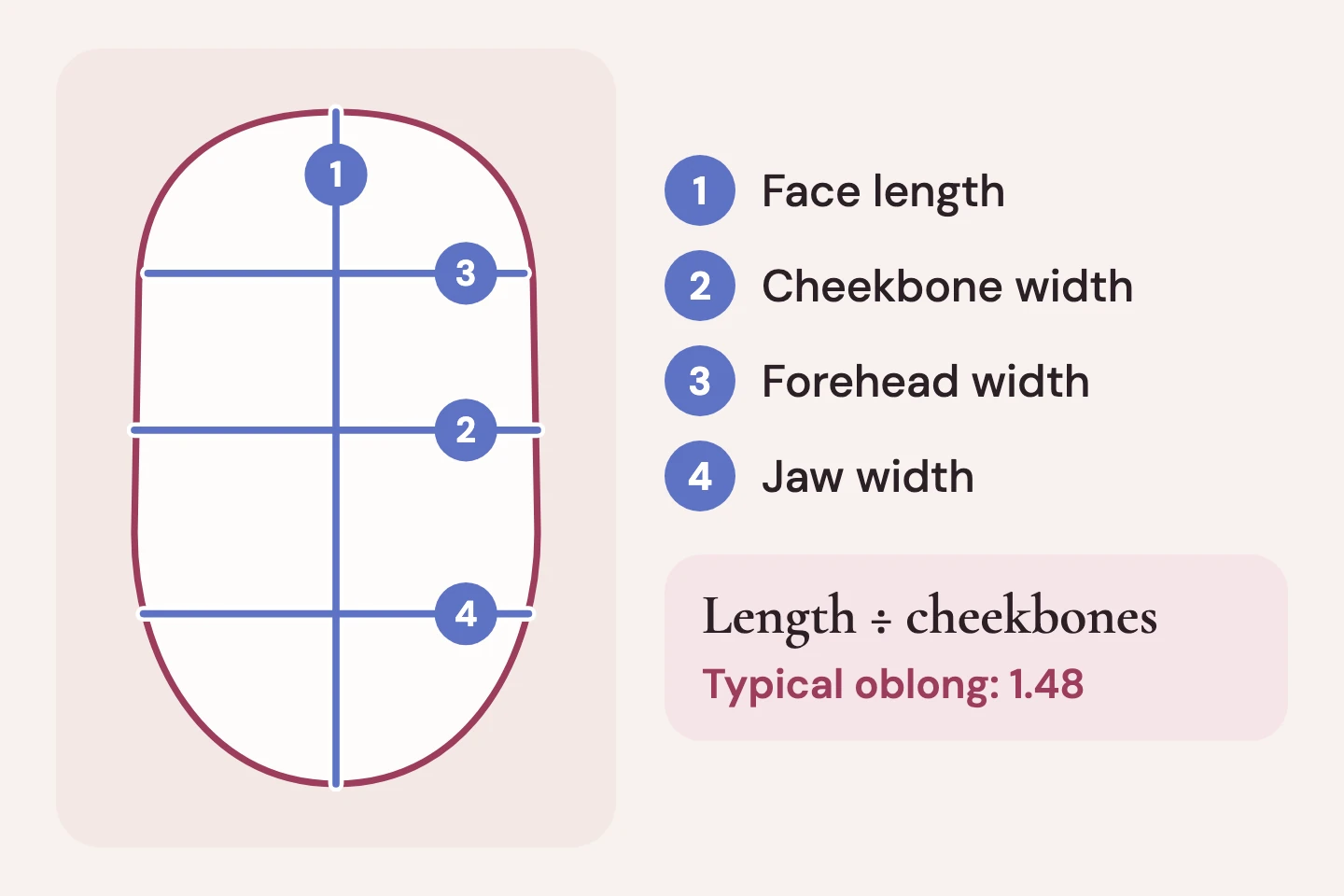
Face length. From your hairline to the bottom of your chin, down the middle of your face.
Cheekbone width. Across the widest line of your cheekbones.
Forehead width. At its widest, just above your brows.
Jaw width. Across the angle of your jaw, below the ears.
Divide. Length divided by cheekbone width. A face 20.8 cm long and 13 cm wide gives 1.60.
A result near 1.48 or above, with the three widths close together, points to an oblong face. The face shape calculator does the sum for you: upload a photo or pick "Enter measurements" and type your four numbers, and you get a fit percentage instead of a bare label.
A quick check without a tape
Pull your hair back and face a mirror straight on. Trace your outline on the glass with a washable marker or a bar of soap, then step back and look at the shape. Long with sides that run nearly straight suggests oblong. Long with sides that curve in toward the chin suggests oval. It is a rough test, so measure if the outline looks close.
Why charts disagree on the ratio
You will see 1.5, 1.6 and 1.7 all quoted as the line for oblong, and none of them is a medical standard. Face shape is a styling convention, so each chart picks its own cut-off and measures in its own way.
Two choices move the number most. The first is where the length starts: a line from the top of the forehead is shorter than a line from a high hairline. The second is what counts as width: dividing by the cheekbones, usually the widest line, gives a smaller number than dividing by the jaw.
FaceStats divides by the cheekbones and compares you with typical shapes, where an oblong face sits near 1.48 and an average face near 1.32. Length isn't the whole story either: an oblong keeps forehead, cheekbones and jaw close together, so the widths count as well as the length.
Why your result can change
Your bones don't change between two measurements, but the inputs do.
- Photo or tape: a photo reading starts from an estimated hairline, and the face model evens out widths and lengths, so photos are read on their own scale. Both should point the same way; if they disagree, measure again with care.
- Camera height: a phone held above your eyes stretches the forehead and shrinks the jaw, and held below your eyes it does the reverse. Keep it level with your eyes.
- Expression: an open mouth adds length, so keep a neutral face with your lips closed.
- Hair: hair over your temples or jaw hides the real width. Tuck it behind your ears.
- Where you measure: the jaw line belongs at the angle below your ears, not near the chin, and the forehead line just above your brows. A narrower reading can change which shape fits.
The photo rules cover the rest of a clean setup.
Oval vs oblong face: what is the difference?
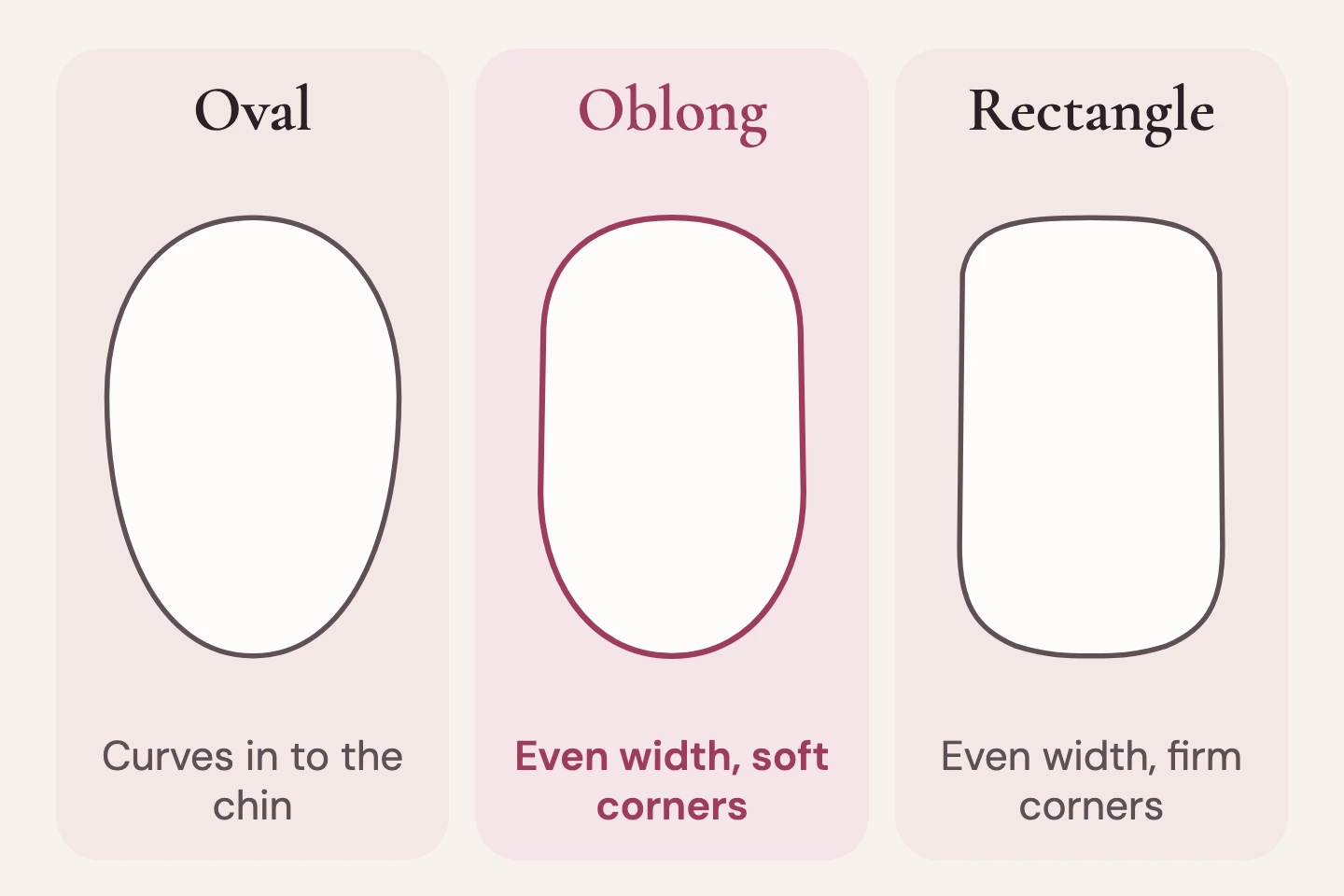
An oblong and oval face shape are both longer than they are wide, so the two are easy to mix up. The difference is in the outline. An oval curves in gently toward the chin, while an oblong keeps its width and runs straighter down the sides.
The ratio settles the oblong vs oval face question only when you sit clearly on one side. Here is what the calculator returns for typed measurements as the length grows, with the forehead at 0.95 and the jaw at 0.90 of the cheekbone width:
| Length ÷ cheekbones | Calculator result |
|---|---|
| 1.36 | Oval, 90% fit |
| 1.40 | Oval, 83% fit, next closest oblong at 83% |
| 1.44 | Oblong, 90% fit |
| 1.48 | Oblong, 93% fit |
| 1.56 | Oblong, 83% fit |
Fit is a similarity to the shape's reference, not a probability, so 83% doesn't mean an 83% chance of being oblong. The fit also falls again past the reference, since a very long face sits further from a typical oblong too.
Long oval face shape or oblong?
If your result sits between the two, you have what many people call a long oval face shape or an oblong oval face shape. That isn't a misreading. Going from 1.40 to 1.44 flips the label but barely changes the face.
Read the fit and the next closest shape together. An oval carries most cuts well, so if you are near the line, start with the side width and soft fringes an oblong benefits from, and keep whatever you already like.
Is an oblong face the same as a rectangle face shape?
Nearly. Most charts treat rectangle as the firmer-jawed version of oblong, and some list a single oblong rectangle face shape. Rectangle usually implies stronger jaw corners and a straighter hairline, while oblong implies softer corners.
The styling goals are the same, so the split matters less than it looks. The calculator doesn't separate them. From a photo it does read the jaw corner, but length outweighs it, so a long face with a square jaw still comes back oblong. A square face shares those even widths but is far shorter: about 1.24 times the cheekbones, against about 1.48 for oblong.
Best oblong face shape hairstyles
Most advice aims for balance: add width at the sides and break up the long vertical line. That is an option, not a correction. If you like your length, wear what you enjoy.
| What tends to help | What tends to add length |
|---|---|
| Volume at cheek or jaw level | Extra height at the crown |
| A fringe across the forehead | A slicked-back top |
| Cuts ending between chin and collarbone | Very long, flat, straight hair |
| Soft waves and side layers | A centre part with flat sides |
Haircuts for oblong face shape women
- Curtain bangs with long layers: the parted fringe frames the forehead and cheekbones.
- Chin-length bob: a clean line at the chin adds width low on the face.
- Long bob or wavy bob: movement between chin and collarbone keeps the sides full.
- Soft collarbone layers: an easy length that suits most faces and frames this one well.
- Blunt shoulder-length cut: one length adds weight and width.
Haircuts for oblong face shape men
Keep the sides a little fuller than a high skin fade leaves them, and bring the top forward rather than up.
- French crop: a short fringe shortens the face and covers a high hairline.
- Textured crop: short sides with a light, forward-leaning top.
- Low fade with curls: natural curls on top, with the fade kept low.
- Medium tapered curls: soft width around the ears and temples.
A beard kept short at the chin and fuller along the cheeks adds width rather than length.
At the salon, describe the goal rather than the label. Ask to keep the weight at cheek or jaw level, to avoid layers that lift the crown, and to try a fringe a little long at first. Bring a photo of the length you want, taken from the front.
Your hair's texture, density and hairline matter as much as your shape. The face shape and hairstyle guide compares all seven shapes, and the sample report shows how the full report previews cuts on a photo.
Oblong face shape glasses, makeup and necklines
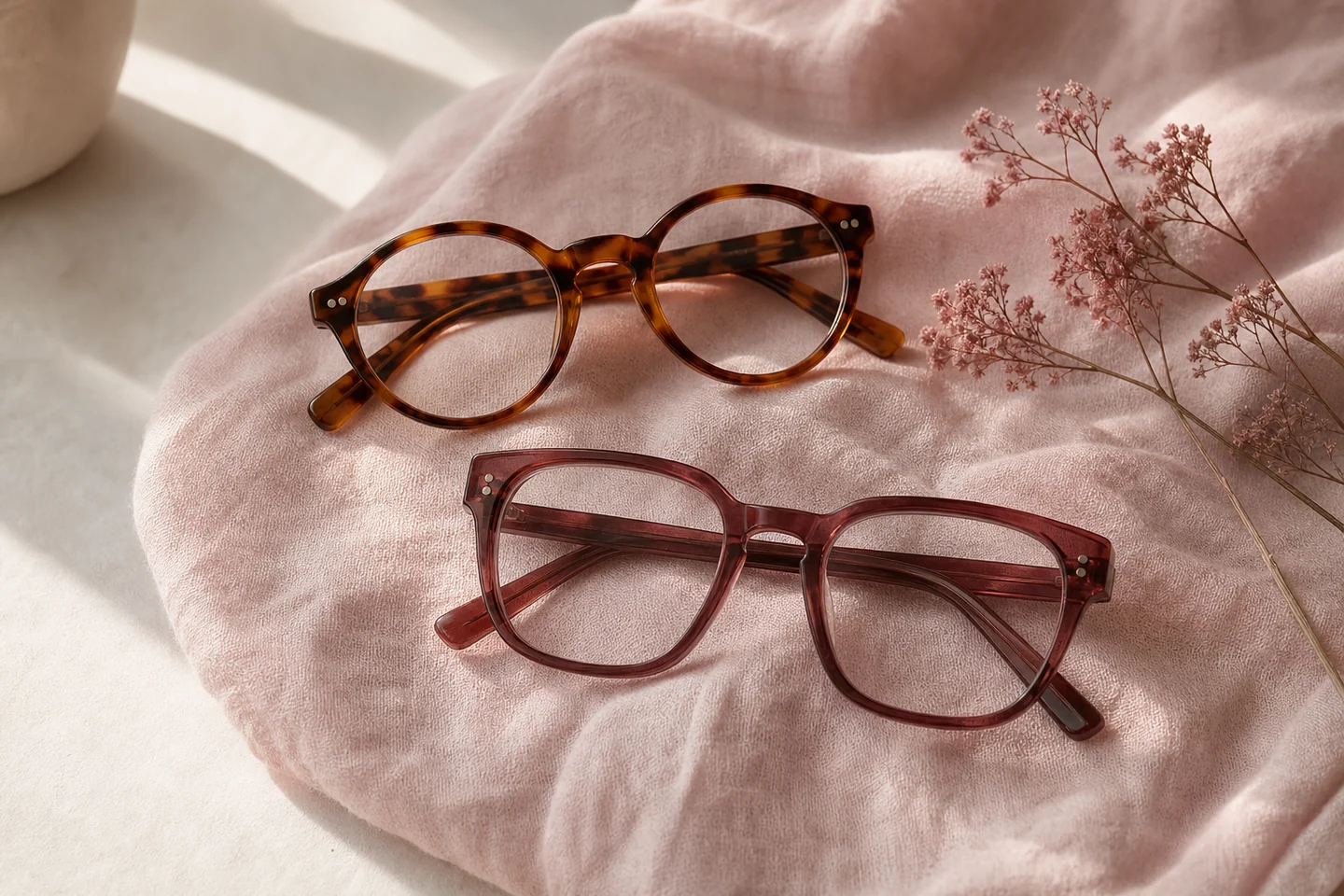
The same idea carries over: let width and horizontal lines do the work. Glasses help when the frame has some depth and hurt only when it is small and narrow, which draws the eye up and down the face.
| Choice | What tends to work |
|---|---|
| Glasses | Deep square or round frames with a strong bridge |
| Sunglasses | Oversized, deep or wraparound shapes |
| Blush | Swept out toward the ears, not down the cheek |
| Contour | A little along the hairline and under the chin |
| Necklines | Crew and boat necks, which add width |
| Earrings | Studs and wide hoops rather than long drops |
The rule for oblong face shape sunglasses is the same as for clear frames: pick a lens deep enough to cover some of the length, and skip slim rectangles.
Oblong face shape questions
Is oblong a good face shape?
Yes, in the sense that there is no bad one. Face shape describes proportions, and taste in faces differs from person to person and place to place. Our calculator ranks no shape above another, so read an oblong result as a styling starting point and not as a verdict on your looks.
Are oblong faces rare?
No, they are a familiar type, but nobody has a reliable count. The percentages you see online mostly come from people who uploaded a photo to a face shape tool, and each tool uses its own cut-off. Those figures don't compare well, so treat any exact share with caution.
What does an oblong face shape mean?
It means your face is clearly longer than it is wide, with similar widths from forehead to jaw. That is all it means. It says nothing about your personality or character, whatever a face reading chart may claim. It is a handy starting point for choosing a haircut or a pair of frames.
Do bangs suit an oblong face shape?
Usually, yes. A fringe covers part of the forehead, which shortens the line from hairline to chin. Curtain bangs and side-swept fringes are easy starting points, and a full fringe has a stronger effect. Your hair's texture and any cowlicks matter, so talk to a stylist before a big change.
Can an oblong face shape change?
Your bone structure stays put in adulthood, but the measured result can move with weight, age, your hairline and the photo itself. Styling can't turn it into a heart or square shape. It only changes what the eye notices first. Compare results only when they were measured the same way.
Is it different for men and women?
The ratios are the same, and the calculator uses one set of shapes for everyone. What differs is the styling that people usually reach for: fringes and layers on longer hair, fuller sides and forward-styled tops on shorter hair. Choose by your hair and your routine, not by a chart.
Not sure where you land? Check your oblong face shape with the free calculator: upload a photo or type your four measurements, then see your shape, its fit and the next closest one. It all runs in your browser, with no sign-up.