Triangle face shape: how to spot and style it
Triangle face shape guide: how to measure a jaw wider than your forehead, tell it from pear and heart, and pick hairstyles and glasses that suit it.
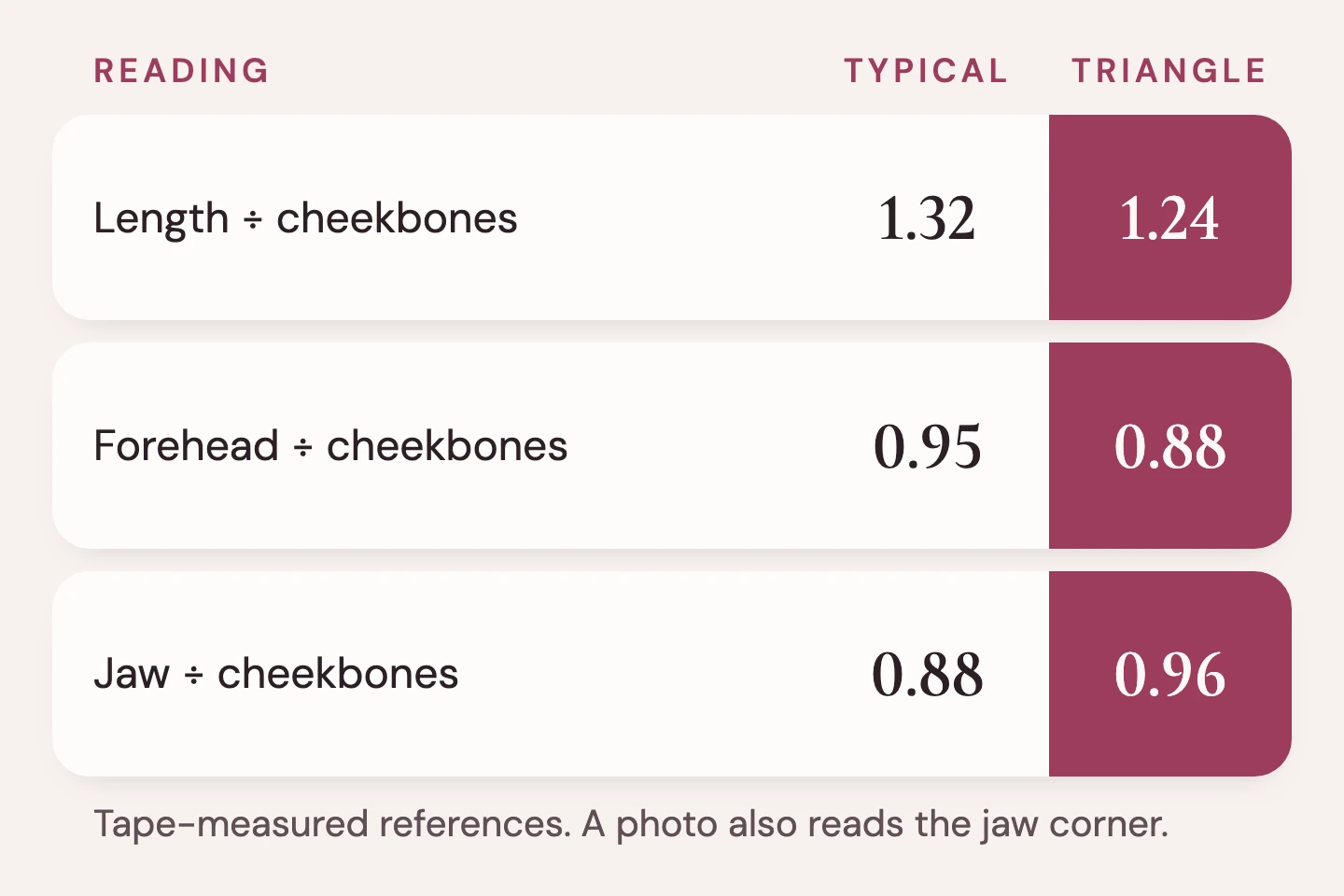
A triangle face shape is wider at the jaw than at the forehead, so the outline narrows as it rises. Charts also call it a pear shape. On the FaceStats reference, a typical triangle has a forehead about 0.92 times the width of the jaw, with the jaw nearly as wide as the cheekbones. This guide shows you how to check your own numbers, how to tell this shape from its lookalikes, and which hairstyles, glasses and makeup work with it.
What is a triangle face shape?
It is an outline with its narrowest line at the forehead and its wide end at the jaw, with the cheekbones usually somewhere between the two. You may also see it called a triangular face, a triangle shaped face or a pear shaped face. All of those names describe the same proportions.
People with this outline often notice a full lower face, temples that look close together and a chin that is broad or flat rather than pointed. Those are common signs, not requirements. A soft jaw and a sharp one can measure the same, because only the width counts.
The name is a description and nothing more. It tells you how your widths relate to each other, which helps when you choose a haircut or a pair of frames. It says nothing about your health, your personality or how good you look.
How to tell if you have a triangle face shape
Measure four lengths, then compare your forehead with your jaw. A soft tape and a mirror are enough, and any unit works as long as all four numbers match.
Pull your hair back Tie it away from your face. Hair over the temples hides forehead width and can make an ordinary forehead look narrow.
Measure your forehead Go across at the widest point, just above the brows, and keep the tape level.
Measure cheekbones and jaw For the cheekbones, take the widest line from one outer edge to the other. For the jaw, go across its angle from corner to corner.
Measure face length Go from hairline to chin, straight down the middle of your face.
Divide forehead by jaw A result near 0.92 or lower points to a triangle, as long as the jaw comes close to the cheekbones. On a 14 cm jaw, that means a forehead of about 12.9 cm or less.
Would you rather skip the tape? The free face shape calculator finds the same four lengths from a front-facing photo, on your device, and draws the lines on your picture. A low camera or a lifted chin changes which width the lens sees, so follow the photo rules before you trust a result.
Why a wide jaw alone is not enough
The calculator weighs three readings together: length, forehead and jaw, plus the jaw corner from a photo. A long face or a jaw that stays well inside the cheekbones can point elsewhere, so a wide jaw does not guarantee this result.
Here is how that plays out with example measurements in centimetres, run through the calculator. They are illustrations, not real people.
| Forehead, cheekbones, jaw, length | Result |
|---|---|
| 11.5, 13, 14, 17.5 | Triangle, 57% fit, with square next at 50%. Forehead ÷ jaw is 0.82 and the jaw is the widest line. |
| 11, 13.5, 13.4, 17.5 | Triangle, 70% fit. The ratio is 0.82 again, though the cheekbones edge out the jaw. |
| 11.8, 13, 14, 17.5 | Triangle, 55% fit, with square close behind at 53%. The ratio is 0.84 and the jaw is very wide. |
| 11.5, 13, 14, 21 | Oblong, 24% fit, with triangle next at 16%. Length is 1.62 times the cheekbones, which outweighs the widths. |
The second row matters most. Many charts say the jaw must be the widest line on your face, but here the cheekbones are a touch wider and the result is still a triangle, and the clearest one in the table, because the gap between forehead and jaw shapes the outline. The first and third rows show the other edge: a jaw that runs wider than the cheekbones pulls a face toward square too. Fit is a similarity, not a probability, and a lower fit means you sit closer to another shape.
Triangle vs pear, heart and square
Only one of these is the same shape under another name. For the rest, look at where the width sits.
| Shape | How it differs |
|---|---|
| Pear | It doesn't. Pear face shape is a second name for this outline. |
| Heart | The reverse outline: a forehead about 1.25 times the jaw, narrowing to the chin. |
| Inverted triangle | Another name for that top-heavy outline, so it is the opposite of a triangle. The calculator returns it as heart. |
| Square | Forehead and jaw are close, both near the cheekbone width, and the face is short. |
| Diamond | The cheekbones stand out, with forehead and jaw both well inside them. |
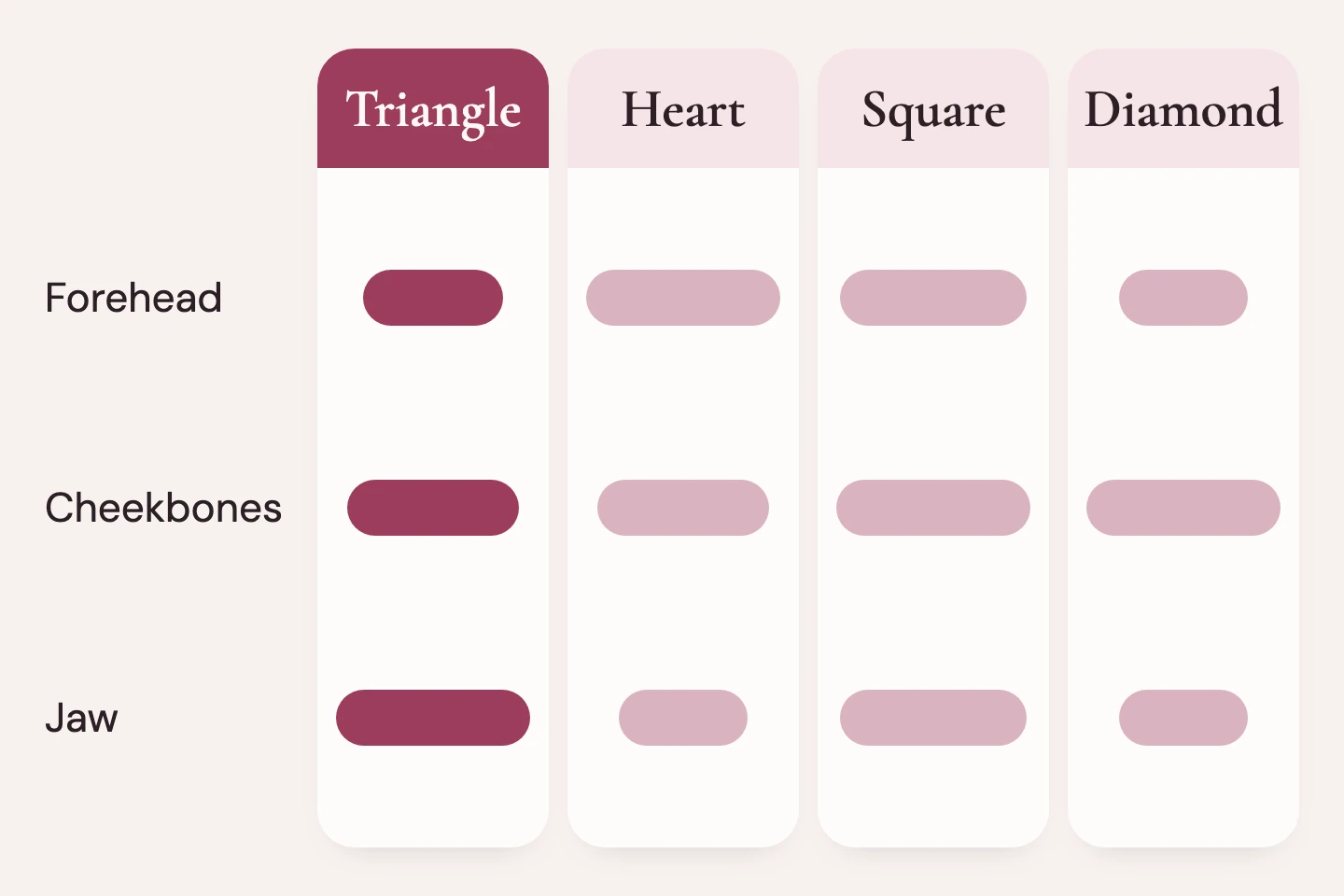
Heart and triangle are mirror images: one narrows at the jaw, the other at the forehead. Square is the easy mix-up, because a strong jaw feels like the whole story. Check the forehead before you decide. If it roughly matches your jaw, you are closer to square, however broad the jaw looks.
How rare is a triangle face?
Nobody has a reliable number. One face shape site says 10–15% of people have it, a figure AI search summaries repeat. Another reports about 0.03% of its own scans. Those claims sit several hundred times apart, and neither comes with a study behind it.
The gap makes sense once you ask what each number counts. Every tool draws its cut-off in a different place, so a strict line finds few triangles and a loose one finds many. Scan counts also cover only the people who chose to use that tool, which is not the same as the population. The FaceStats calculator saves nothing when you run it, so we have no count of our own to add.
Treat any percentage you read as one site's line, not a fact about people. Your own forehead-to-jaw ratio tells you more than any share could.
Is a triangle face shape attractive?
Yes, as much as any other shape can be. Attractiveness depends on taste, culture and who is looking, and no outline wins on its own. Charts often praise the oval, but that comes from styling tradition rather than measurement. The jawline behind this shape is a feature many people read as strong and striking.
The face shape calculator gives no shape a score. It sorts proportions and stops there. If you want a reading of facial balance instead, the AI attractiveness test looks at symmetry and proportions from a photo. That is a separate question, and any score describes one picture, not your worth.
Best hairstyles for a triangle face shape
Good cuts for this outline do two jobs: they add height and volume near the crown, and they keep weight away from the jaw. That evens out the proportions without hiding anything. The face shape and hairstyle guide sets out the same logic for all seven shapes.
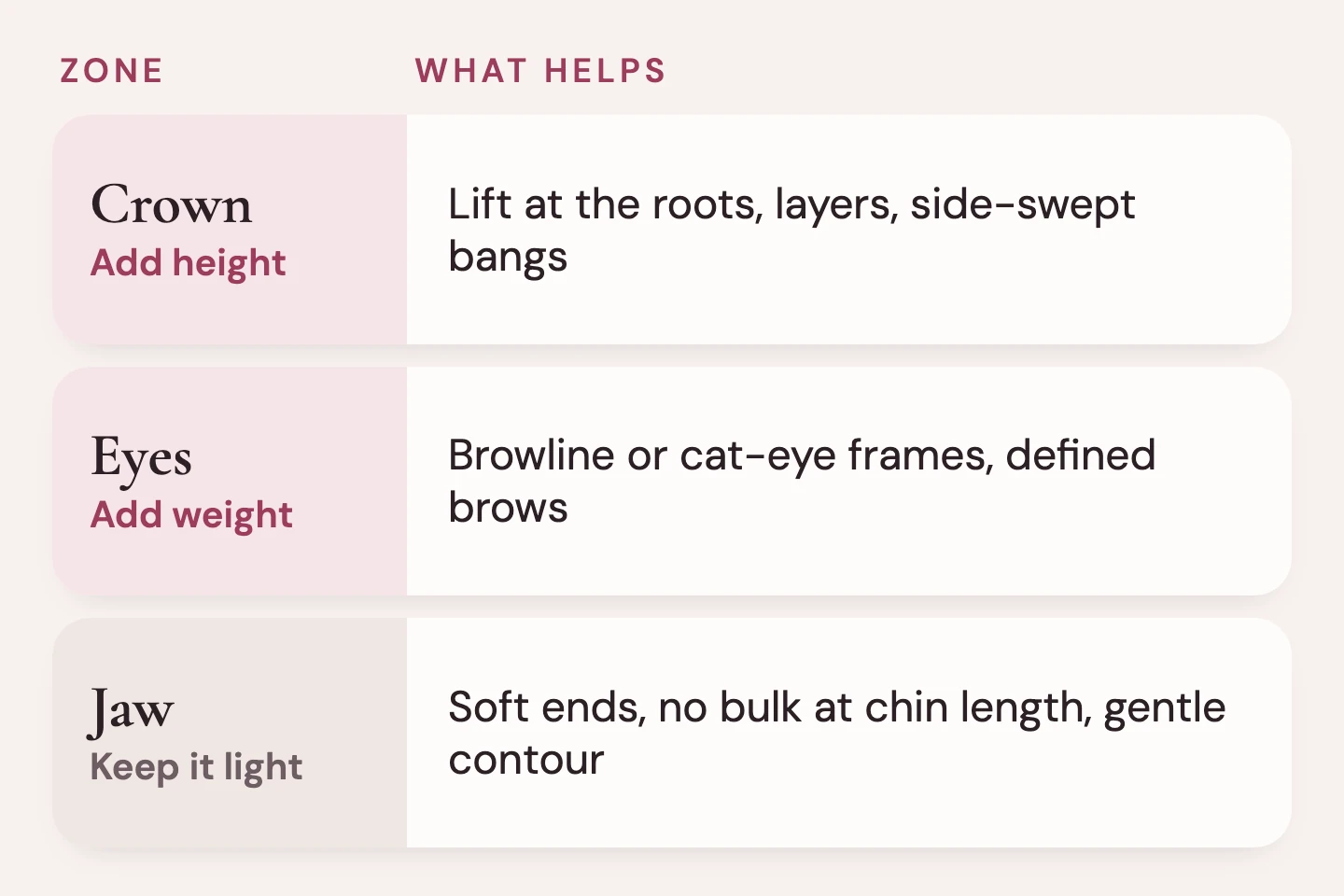
None of this is a rule. If you love your jawline, a cut that shows it off is a perfectly good choice.
Triangle face shape women's hairstyles
The easiest hairstyles for triangle face outlines keep movement above the jaw. These are the ones to ask a stylist about:
- Layers that start at the cheekbones. They lift the upper half and stop the ends from bunching at the jaw.
- Side-swept or curtain bangs. The best bangs for triangle face shape outlines widen a narrow forehead, and a light fringe does this better than a heavy blunt one.
- A textured pixie. Close sides with a lifted top put the volume exactly where you want it.
- Long hair past the collarbone. Length that falls well below the jaw draws the eye down rather than out.
- High buns and updos. Lift at the crown does the work, and a few loose pieces at the temples soften the look.
Haircuts and beards for men
The best haircuts for triangle face shape men put height on top and keep the sides tidy. Most triangle face shape hairstyles men choose come down to a handful of cuts:
- Quiff. Height at the front adds to the upper half, and it works on most hair types with a little product.
- Pompadour. A fuller version, combed back, with volume across the whole top.
- Textured fringe. Worn forward, it adds width across a narrow forehead.
- Side part with volume. A cleaner choice for work, as long as the top keeps some lift.
A beard changes the jaw directly. Keep the sides short and let any length sit at the chin, so the lower face reads narrower. Heavy sideburns and full cheeks add width exactly where you already have it.
Cuts to skip
Triangle face shape haircuts tend to go wrong in the same few ways:
- Blunt, chin-length bobs that end at the widest point of the jaw.
- Flat, slicked-down tops with no height at all.
- Curls or waves that only begin at jaw level.
- Heavy, one-length ends that sit on the jawline.
Bring your stylist or barber the reasoning as well as a picture. Your hair texture and your morning routine decide which of these will hold up at home.
Best glasses for a triangle face
Glasses for triangle face outlines follow the same idea as the haircuts: put the visual weight at the top. A frame with a strong upper line adds width at the brow and balances a wider jaw.
- Everyday glasses. Browline frames, cat-eye frames or any shape with a bold top edge.
- Sunglasses. The best sunglasses for triangle face shape outlines are aviator, browline or cat-eye styles.
- Frames to skip. Bottom-heavy shapes add weight low on the face and make the jaw look wider.
Whatever you pick, keep the frame no wider than your face. If you are between two pairs, look straight into a mirror and choose the one that draws your eye to the brow line first.
Makeup, necklines and earrings
The small details follow the same plan: bring light up high and keep things quiet down low. All of it is optional, and a little goes a long way.
- Contour. Blend a soft shade along the sides of the jaw, where the face is widest.
- Highlight. Add light to the centre of the forehead and the temples.
- Blush. Sweep it high on the cheekbones, toward the temples.
- Brows. A defined brow adds a clear horizontal line to the upper face.
- Necklines. V-necks and scoop necks draw the eye down and away from the jaw.
- Earrings. Studs and slim drops stay out of the way, while wide shapes at jaw height add to the width.
Triangle face questions
What does a triangle face mean?
It means your forehead is clearly narrower than your jaw, so the outline widens toward the bottom. That is all it means. A face shape describes proportions for choosing hair and frames, and face reading traditions that tie shapes to personality have no evidence behind them.
Are triangle and pear face shapes the same?
Yes. Triangle and pear are two names for one outline, with a narrow forehead and a wider jaw. Charts tend to pick one name or list both. The styling advice is identical, so anything written for a pear shape applies to you, whichever word your result uses.
Is a triangle face the same as an inverted triangle?
No, they are opposites. A triangle face is wide at the jaw and narrow at the forehead. An inverted triangle, sometimes called an upside down triangle, is wide at the forehead and narrow at the chin. The FaceStats calculator returns that second outline as a heart shape, so look there for advice.
Can a triangle face change?
A little. Weight changes, ageing and dental or jaw treatment can alter your widths, so an old result may stop fitting. Bone structure keeps the broad outline steady in adulthood, which means most adults stay close to the same shape. Measuring again after a big change takes only a minute.
Does this shape look different on men and women?
The outline is the same, and the calculator uses one set of shapes for everyone. What changes is the styling: beards and barber cuts on one side, bangs and updos on the other. Choose from both lists if you like, because the balance idea works whatever your gender.
Which hairstyle is best for a triangle face?
There is no single best cut, but the strongest choices add height at the crown and keep weight off the jaw. Layers starting at the cheekbones, side-swept bangs and a textured pixie suit many people, and a quiff does the same job on short hair. Your hair texture should decide between them.
Are there famous people with triangle face shape?
Lists exist, but they are guesses made from photos, where hair, camera angle and lens all change the outline. Nobody measured those faces, so we name no one here. Comparing yourself with a celebrity tells you little. Your own four measurements tell you far more about which cuts and frames will work.
Measure your own face
You know what to look for, so the last step is your own numbers. Check your triangle face shape with the free calculator: upload a front-facing photo or type in four measurements, and you get your shape, how closely you fit it and the next closest match, with no sign-up. The photo stays on your device. If you would like to see cuts on your own face before a salon visit, the sample report shows what the optional full report adds, including six hairstyle previews on your photo.