Diamond face shape: how to tell and style it
A diamond face shape has cheekbones wider than its forehead and jaw. Learn to measure it, tell it from heart or oval, and pick cuts and frames that suit it.
If your cheekbones are the widest part of your face and your forehead and jaw are both clearly narrower, you have a diamond face shape. A mirror gives you a quick answer, and three widths from a tape measure give you a firm one. This guide shows how to check, how to tell it apart from heart and oval, why the "rarest shape" claim is shakier than it sounds, and which haircuts and glasses suit it.
What is a diamond face shape?
It is a face that is widest through the middle and narrows at both ends, like the outline of a kite. The cheekbones set the width. The forehead and the jaw both sit well inside them, at close to the same width as each other, and the chin usually tapers. The face is longer than it is wide.
The features of a diamond face shape come down to four lines:
- Cheekbones: the widest line of the face, usually easy to see.
- Forehead: clearly narrower than the cheekbones, often drawing in at the temples.
- Jawline: clearly narrower than the cheekbones, running in toward the chin.
- Length: longer than the width, but not as long as an oblong face.
A diamond shape face is a description of proportions, not a rating. It tells you where the width sits, which helps when you choose a cut or frames.
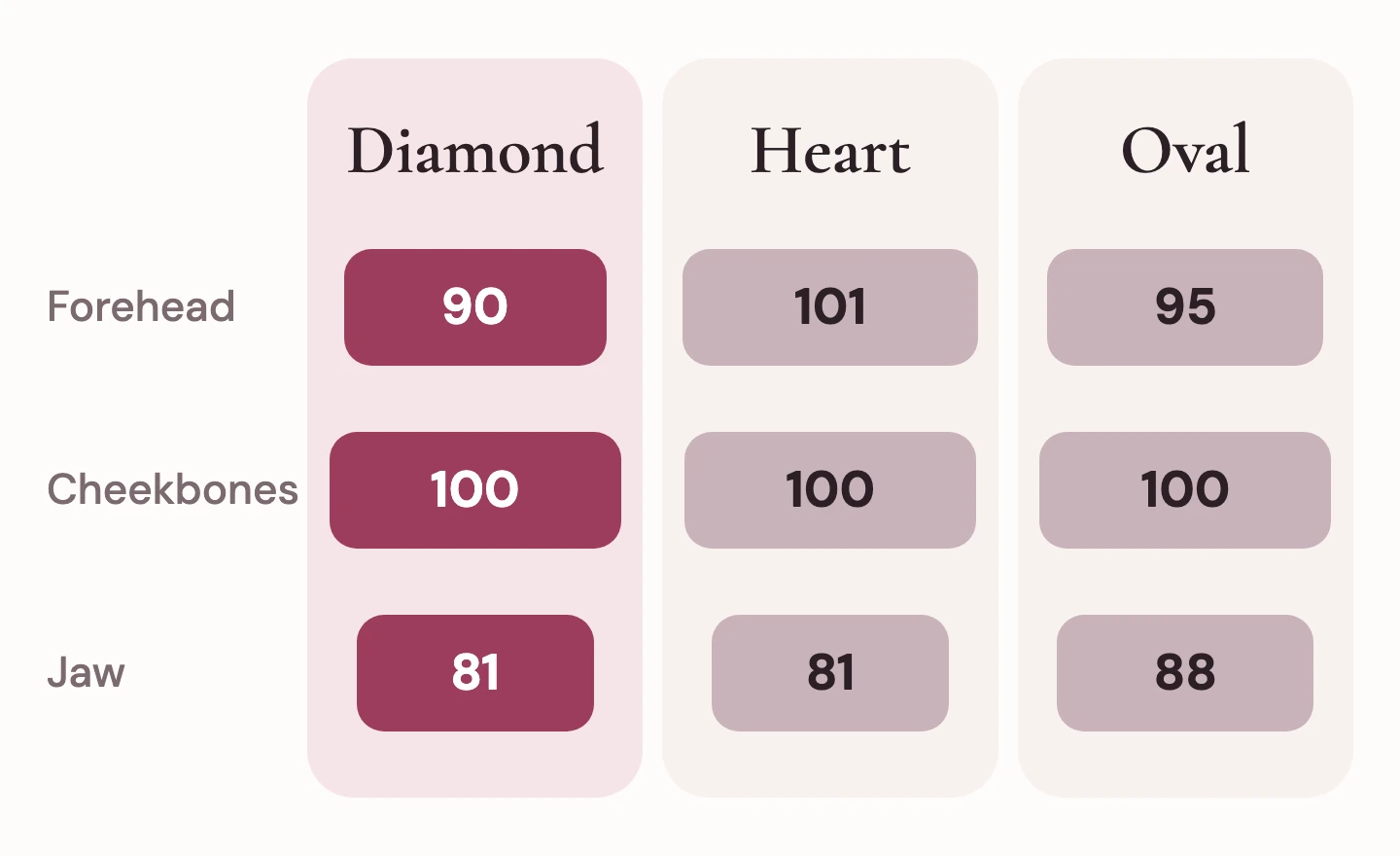
In numbers, a typical diamond on the FaceStats reference has a forehead near 0.90 and a jaw near 0.81 of the cheekbone width. Both ends sit clearly inside the cheekbones, and neither comes close to matching them.
How to tell if you have a diamond face shape
Tie your hair back, take off your glasses and relax your face.
The mirror check
Stand square to a mirror in soft light and compare three lines: across your forehead, across your cheekbones and across your jaw. A diamond face shows cheekbones that stand out past both other lines, with the sides of the face angling inward above and below them. If the forehead looks about as wide as the cheekbones, you are probably looking at a heart or an oval instead.
The tape measure check
Hold a soft tape or a ruler straight across, rather than letting it follow your skin.
Cheekbones. Measure across the widest point, just below the outer corners of your eyes.
Forehead. Measure across its widest point, about halfway between your brows and your hairline.
Jaw. Measure between the two jaw angles, just below your ears.
Compare. Add forehead and jaw, halve the total, then divide your cheekbone width by that number.
A typical diamond lands near 1.17 on this sum, against about 1.09 for an oval face, as long as the cheekbones are also wider than each of the other two. Say your cheekbones measure 13.5 cm, your forehead 11 cm and your jaw 11 cm. The average of forehead and jaw is 11, and 13.5 divided by 11 is about 1.23, well past the diamond reference. With a face about 18 cm long, the calculator names diamond at a 66% fit. Very long faces are the exception: past about 1.5 times the cheekbones, oblong usually fits better.
The FaceStats face shape calculator doesn't stop at one sum: it compares your length, forehead and jaw with seven typical shapes and names the closest. Face shapes have no official standard, so another chart may draw the line somewhere else.
What a photo can get wrong
A diamond result depends on small differences in width, so the camera matters. Held too high, a phone shrinks the jaw and stretches the forehead. Held low, it does the reverse. A turned head narrows every width, a smile lifts the cheeks, and hair over the temples hides the edge of the forehead. Follow the photo rules before you trust one picture, and take a second if your result looks borderline.
Many charts also list a pointed chin as a sign of this shape. The calculator reads widths, length and, from a photo, how sharply the jaw turns, but it doesn't judge chin shape. Two faces with the same readings get the same result, even if one chin is sharper.
Is it diamond or something close?
Three shapes are easy to confuse with diamond, and comparing the widths usually settles it.
| Shape | What sets it apart from diamond |
|---|---|
| Heart | The forehead stays wide and only the jaw narrows |
| Oval | All three widths are closer, with gentle curves |
| Oblong | Much longer, with fairly even widths |
Diamond vs heart face shape
Both narrow toward the chin, so the forehead decides it. A heart shaped face keeps a wide forehead, typically about 1.25 times the width of the jaw, and it often reaches about as far as the cheekbones. A diamond face pulls in at the forehead as well. Put simply, a heart has one narrow end and a diamond has two.
Oval vs diamond face
To work out whether you have a diamond or oval face shape, look at how quickly the width falls away from the cheekbones. An oval curves gently, so the forehead and jaw stay close to the cheekbones. A diamond steps in much further on both sides. The two can share the same length, which is why a quick look can mislead.
Soft diamond shape face
"Soft diamond" is an informal label for diamond proportions with rounder edges, or for a face that sits between oval and diamond. It isn't a separate category in most charts, or in our calculator. Near a boundary, the calculator names one shape and shows the next closest with its own fit. If you get diamond with oval close behind, use the advice the two share.
How rare is a diamond face?
It is often called the rarest shape, at about 5% of people, but nobody has counted. There is no census of face shapes, and the figures you read come from face shape tools counting their own users.
We checked three published tallies, each based on 15,000 to 51,000 analyses. Two put diamond at about 5%, the lowest share of any shape. The third puts it near 25%, about one face in four.
Two things explain the gap. Each tool draws its own line for "clearly wider cheekbones", so a looser rule finds more diamonds. And everyone counted chose to use a face shape tool, so they aren't a random sample, as two of those tools say themselves. The fair summary is that nobody knows the real figure. FaceStats publishes no share for any shape, and the calculator keeps no record of your result.
Diamond face shape hairstyles
Good haircuts for diamond face shape proportions share one idea: add fullness at the forehead and the jaw, where the face is narrow, and keep extra volume off the cheekbones, where it is already wide. There is no single best haircut for diamond face shape balance, because your hair type and the time you want to spend on it matter just as much.
A good diamond face shape hairstyle does at least one of these jobs:
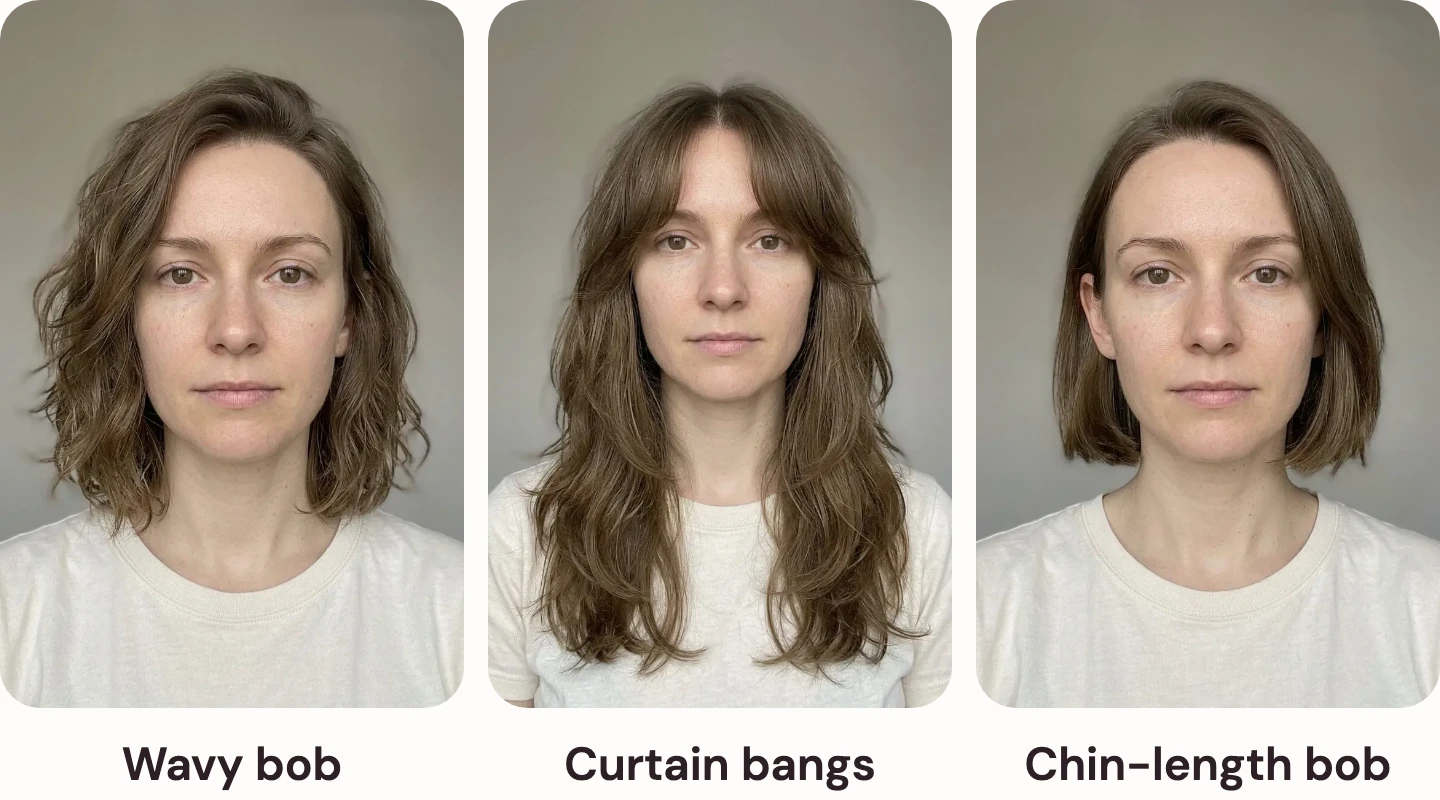
- Widens the forehead with a side-swept fringe, curtain bangs or a soft side part.
- Widens the jaw with a chin-length bob, a lob or layers that start at the chin.
- Softens the cheekbones with face-framing pieces that fall past them rather than stopping on them.
Cuts for diamond face shape women
Chin-length to collarbone-length cuts do the most, because they put fullness right where the jaw narrows. A wavy bob, a lob or soft layers at the collarbone all fit. Long hair works too when the layers begin around the chin. A deep side part or curtain bangs take care of a narrow forehead. A soft pixie shows the cheekbones, so it suits people who like them on show.
The face shape and hairstyle guide applies the same logic to all seven shapes.
Cuts for diamond face shape men
Bringing hair forward or to one side does the most for a narrow forehead. A classic side part with tapered sides suits this shape, and so do medium curls or a textured top pushed forward. Keep some length at the sides, because a very tight fade makes the cheekbones look wider by comparison. A short beard or stubble adds a little width along the jaw. A slick back or a buzz cut shows the whole face, so pick one of those if you like your cheekbones on show.
What makes cheekbones look wider
Three things pull the eye to the widest line: volume that sits at cheekbone level, hair pulled tight at the sides, and a blunt edge that ends right on the cheekbones. Treat these as trade-offs, not rules. Many people like their cheekbones, and a diamond face hairstyle that shows them off is a fair choice.
Best glasses for diamond face shape
The best glasses shape for diamond face proportions has a defined top line and reaches at least as wide as the cheekbones. A clear brow line adds visual width near the forehead, which balances the cheekbones below it.
- Cat-eye: lifts the eye outward and adds width at the temples.
- Oval: soft curves that sit well against angular cheekbones.
- Browline: a strong top bar with a lighter lower rim.
- Rimless with a defined top: the lightest choice, if you want the frames to stay quiet.
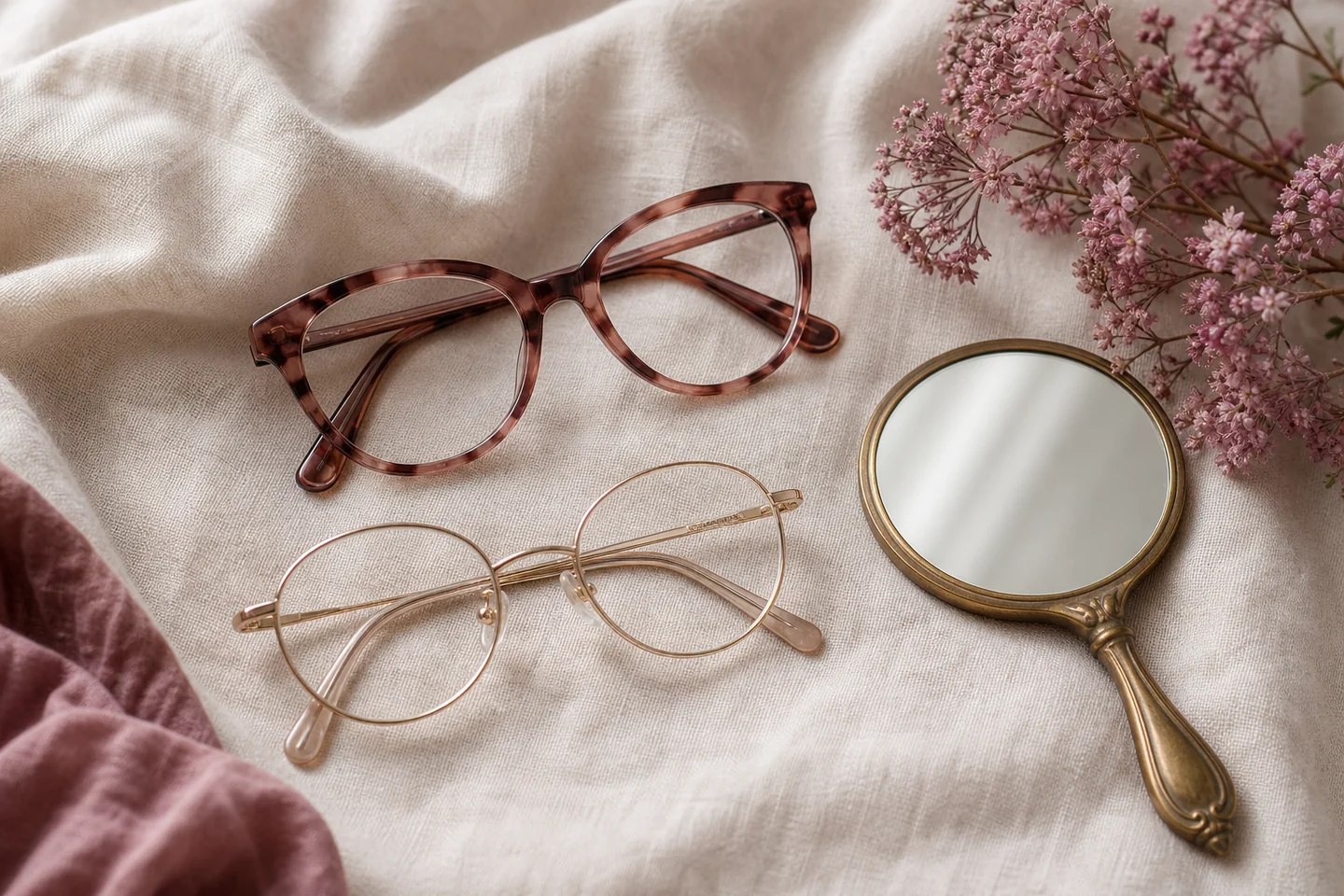
Skip narrow frames that sit inside the cheekbone width, because they make the cheekbones look wider by comparison. The same thinking applies to sunglasses on a diamond face: cat-eye, oval and browline shapes all carry over.
Brows and makeup for a diamond shaped face
Both are optional and follow the same idea as the hair. A softly curved brow suits the angles of a diamond face, and a tail that runs a little longer can make a narrow forehead look wider. For blush, stay on the apples of the cheeks rather than sweeping high toward the temples. If you contour, a light touch just below the cheekbones is enough, and a little highlight on the centre of the forehead and the chin draws attention to the narrow ends.
Is a diamond face shape attractive?
It can be, as any face shape can. The calculator doesn't rank shapes: its ratios describe where width sits and say nothing about attractiveness. Some articles call diamond the most photogenic shape, but there is no measurement behind that. How a face looks to other people depends on expression, skin, styling and who is looking.
Diamond face questions
Do people with a diamond face shape have a slim face?
Often it looks that way, because the forehead and jaw are narrow and the face is longer than it is wide. The shape is about proportions, though, not size or weight. A fuller face can still be diamond when the cheekbones stay clearly wider than the other two lines.
Can a diamond face change with weight or age?
Adult bones change little, but the measured shape can move. Weight changes can soften or sharpen the jaw and cheeks, and ageing can shift how full they look. Jaw treatments can change the numbers too. Measure under the same conditions before you compare one result with another.
Do bangs suit a diamond face?
Usually, yes. Side-swept bangs and curtain bangs add width across a narrow forehead and soften the line from temple to cheekbone. A heavy, blunt fringe can work too, but it hides the forehead completely, so try a softer version first if you are not sure about the look.
What haircut length suits a diamond face best?
Chin-length to collarbone-length cuts are the easiest, because they add fullness at the narrow jaw. Short cuts work when they keep some softness at the forehead and sides. Long hair works when the layers begin around the chin, so the width doesn't stop at the cheekbones.
What if my result sits between diamond and oval?
That is common, and it means your ratios sit close to a boundary. The calculator shows a fit percentage and, when the result is close, the next closest shape. Take a second straight-on photo to check it, then use the styling advice the two shapes share.
Which celebrities have a diamond face?
Lists online name plenty of stars, but they are judged from photos, where angle, makeup, lighting and hair all change how wide a face looks. We can't measure a face from a list, so we name no one here. Your own measurements will tell you far more than a comparison.
Do men and women have different rules?
No. The calculator uses one set of ratios for everyone, so the same widths give the same shape. Styling differs more than the shape does: men often use a beard or a forward fringe, and women often use layers, bobs or curtain bangs. The aim of balance stays the same.
Find your shape
Check your diamond face shape with the free calculator: add one photo or type four measurements, and you will see your shape, its fit and the next closest shape, with no sign-up. Your photo stays on your device. If you would like cuts and frames worked out for your own face, see a sample report of the optional full report, which draws six haircuts on your photo.