Heart shaped face: how to tell if you have one
Learn what a heart shaped face looks like, how to measure yours, how it differs from oval and diamond, and which haircuts and glasses suit it best.
You have a heart shaped face if your forehead is clearly wider than your jaw and your face narrows to a small chin. The quickest test takes two measurements: divide your forehead width by your jaw width, and a result around 1.25 or higher points to a heart. This guide shows how to check yours, how to rule out the shapes it gets mistaken for, and which cuts, frames and makeup work with it.
What is a heart shaped face?
It is a face that is broad at the top and narrow at the bottom, like the outline of a heart. Stylists look at four features, and they have to fit together:
- Forehead: broad across the temples.
- Cheekbones: wide and often high, close to the forehead in width.
- Jawline: clearly narrower, sloping in from the cheeks.
- Chin: small, and soft or gently pointed.
Length matters less. The face is usually a little longer than it is wide, about 1.4 times the cheekbone width, so it rarely reads as square or very long.
The FaceStats calculator compares a face with these reference ratios for a heart:
- 1.3Forehead ÷ jaw
- 1.4Length ÷ cheekbones
- 1.1Cheekbones ÷ average of forehead and jaw
Many charts say the forehead must be the widest part. In practice the forehead and cheekbones are often almost level, and the real sign is the drop from there down to the jaw. You will see the outline written several ways, including heart shape face and heart-shaped face, and they all mean the same thing.
How to tell if you have a heart shaped face
All you need is a mirror, a soft tape measure and a couple of minutes. Pull your hair off your forehead first, because a fringe hides the width that matters.
Trace it in a mirror. Stand square to the mirror and trace your outline on the glass with a washable marker. Look for a line that runs in from the cheeks to a small chin. It is fast, but easy to misjudge.
Measure with a soft tape. Measure across your forehead just above the brows, across the widest part of your cheekbones, across your jaw at its corners, and from hairline to chin. Keep the tape level and write down all four.
Run the numbers. Divide forehead by jaw yourself, or open the free face shape calculator, choose Enter measurements and type all four. Any unit works as long as they match.
What the forehead to jaw ratio means
Divide your forehead width by your jaw width. Units don't matter, so centimetres and inches give the same answer. On the FaceStats reference, a typical heart sits near 1.25 and a typical oval near 1.08. A triangle reverses it, at about 0.92, with its wider end at the bottom. The calculator also weighs your cheekbones and length, so this one ratio points the way rather than settling it.
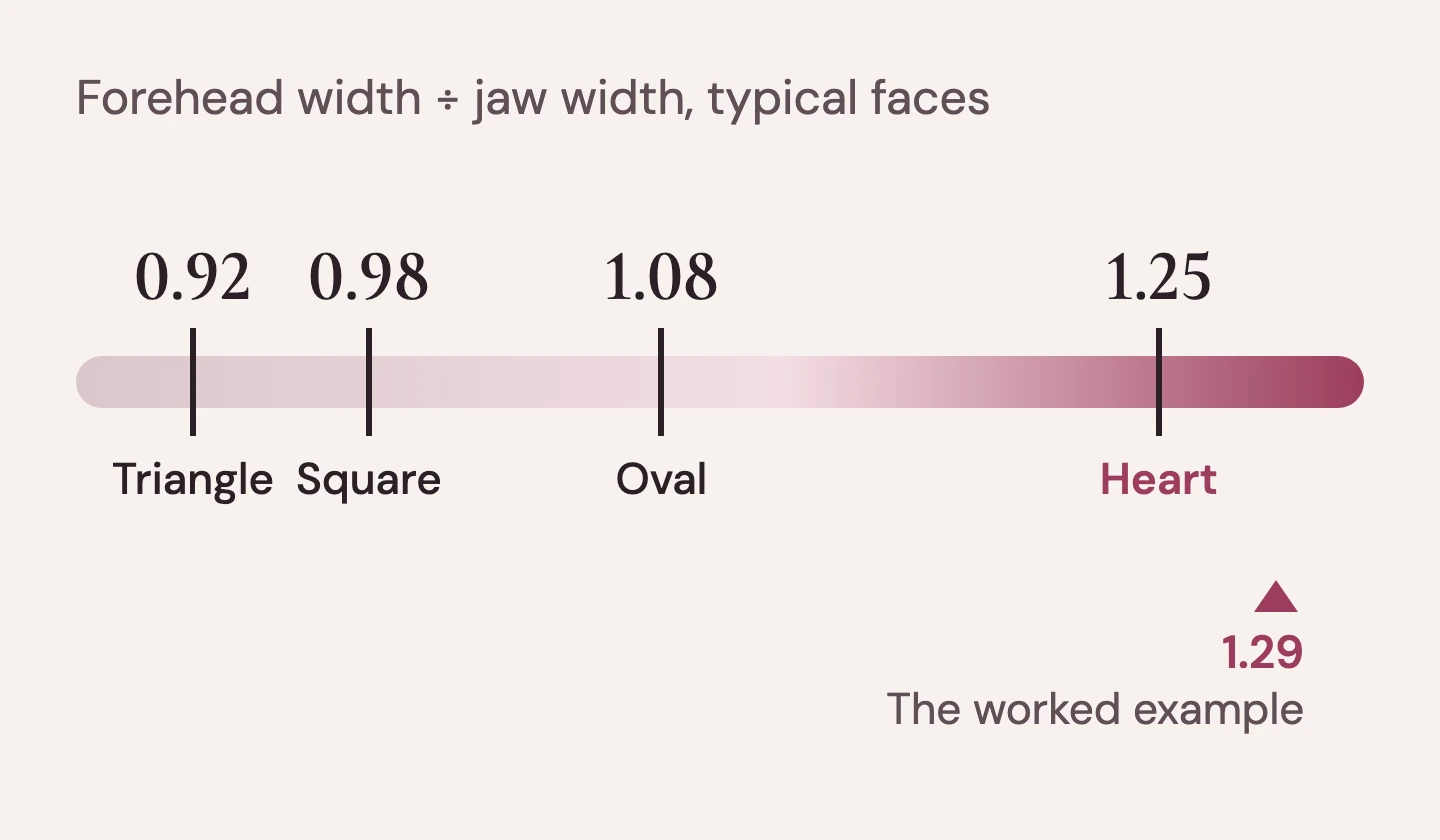
Say your forehead is 13.5 cm, your cheekbones 13.5 cm, your jaw 10.5 cm and your face 19 cm long. Forehead ÷ jaw is 1.29, so the top of your face is about 29% wider than the bottom. The calculator then looks at the whole outline:
- Length ÷ cheekbones is 1.41, a little longer than a typical heart at about 1.33, so oblong comes next.
- Forehead ÷ cheekbones is 1.00, close to a typical heart's 1.01, while a diamond's forehead would sit near 0.90.
Heart is still the closest of the seven shapes, at about an 80% fit. These references are a styling convention, not a medical standard, and a face between two shapes can land on the neighbouring one.
Do you need a widow's peak or a pointed chin?
No. A widow's peak, the V of hair at the centre of the hairline, appears in many descriptions of this shape, but it belongs to your hairline, not your bone structure, and plenty of heart faces don't have one. A pointed chin is common, not required: a soft, rounded chin can sit on the same outline. The calculator measures neither. It reads widths, length and, from a photo, the turn of the jaw, so two people with different chins can get the same result.
Heart face shape vs oval, diamond, round and square
Most doubts come from the shapes next door. Compare the two ends of your face first, then find where the width sits.
Heart shaped face vs oval face
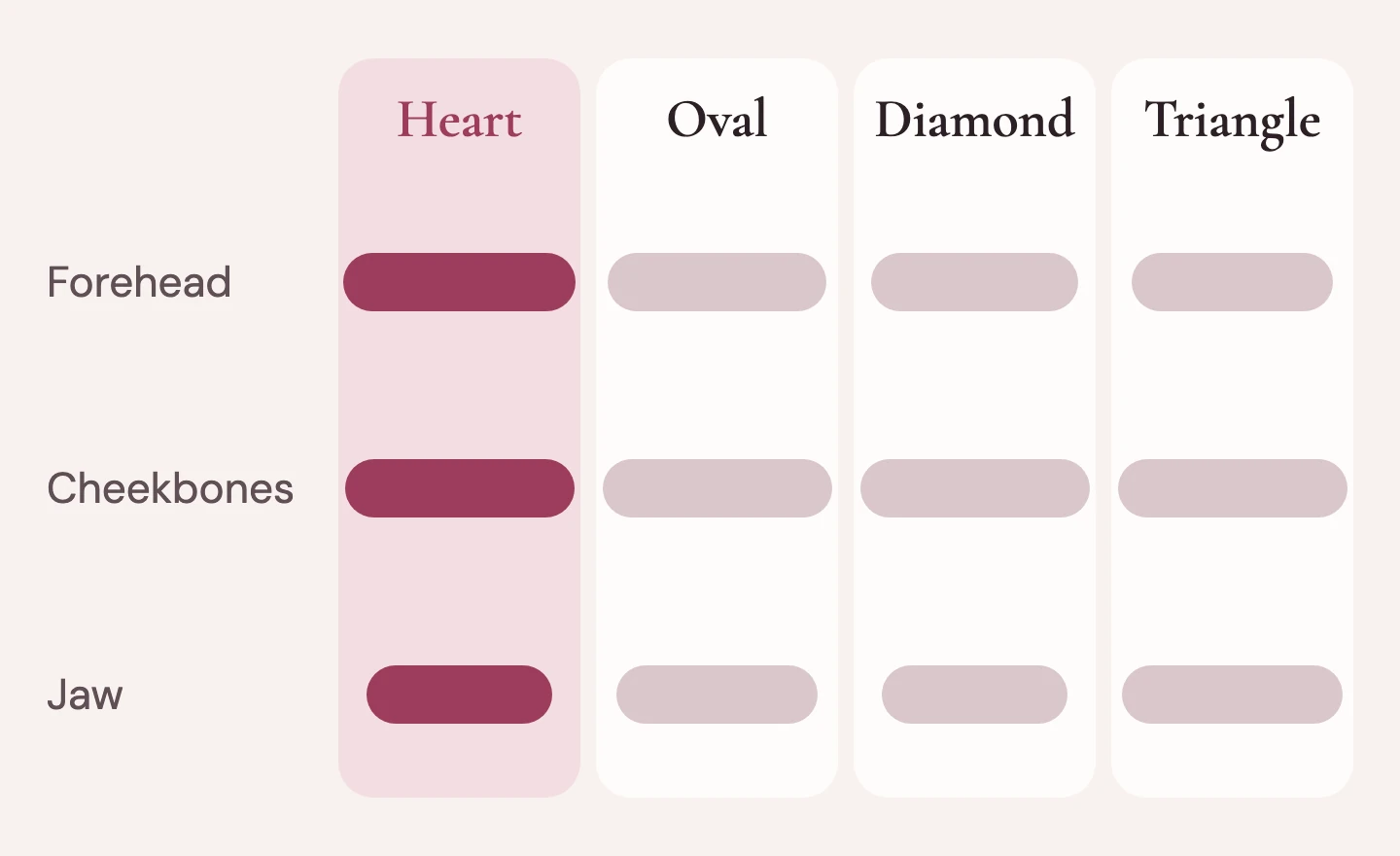
This is the closest call, because both taper. An oval narrows gently, with a forehead only a little wider than the jaw, around 1.08 times on the reference. A heart shows a clear step down. If you land between the two, your fit percentage drops, so a blend of oval and heart is a normal answer, not an error.
Diamond vs heart face shape
Look at the forehead. A diamond has a narrow forehead and a narrow jaw, so the cheekbones stand out alone. A heart keeps the forehead wide, and only the jaw narrows. The calculator weighs both ends together, so a forehead that falls well short of the cheekbones points to diamond even when it is wider than the jaw.
Round and square faces
A round face is almost as wide as it is long, with a full, soft jaw. A heart is longer and slimmer below the cheeks. For square vs heart face shape, ignore the chin and compare the two ends: on a square face the forehead and jaw match, and on a heart the jaw is clearly narrower.
Best haircuts for heart shaped faces
Most hairstyles for heart shaped face types follow one rule: soften the forehead and put fullness at chin level or below. These six cuts do that in different ways.
| Cut | Why it works |
|---|---|
| Curtain bangs with long layers | A parted fringe frames the forehead and cheekbones, and the layers keep movement lower down. |
| Side-swept fringe with layers | A long fringe swept across makes a wide forehead look narrower. |
| Long bob (lob) | It ends between the chin and collarbone, right where the face narrows. |
| Chin-length bob | It adds width at the lower face and gives the jaw a cleaner line. |
| Blunt shoulder-length cut | One length adds weight and width low down. |
| Soft pixie | A longer, textured top shows the eyes and cheekbones without hiding the shape. |
Our face shape and hairstyle guide sets this advice beside the other six shapes. The FaceStats full report goes further and previews six hairstyles on your own photo: the sample report shows how that looks.
Bangs for heart shaped face types
Curtain bangs and long side-swept fringes suit this outline best, because they cross the widest part of the forehead at an angle. A heavy, straight fringe can shorten a tall forehead, but it also draws a hard line across the broadest area, so keep it wispy if you try one.
What to avoid
- Height at the crown. Heavy volume on top adds width where you already have it.
- Hair scraped straight back. It shows the full forehead with nothing to balance it at the jaw.
- All the weight above the ears. Cuts that thin out toward the chin make the taper sharper.
None of this is a rule. If you love a cut, a small change to the fringe or the layers usually makes it work.
Glasses and sunglasses for a heart face
When you choose glasses for heart shaped face proportions, keep the visual weight low. A frame that is heavier at the bottom balances a wider forehead, and one that is heavy on top adds to it.
| Type | What to look for |
|---|---|
| Everyday frames | Oval, round or bottom-heavy shapes, rimless styles, or a light top bar. |
| Sunglasses | Aviators, round lenses or a light cat-eye. |
| Frames to skip | A heavy browline or a decorated top bar. |
The same logic applies to sunglasses for heart shaped face outlines, where a large lens can make the chin look smaller, so try the size in a mirror. For any pair of heart shaped face glasses, check that the frame is about as wide as your temples and no wider.
Makeup for a heart face
Makeup works like hair here: soften the top and add a little presence lower down. These are common habits among makeup artists, not fixed rules.
- Contour: blend a matte bronzer along the temples and the top of the forehead, and leave the jaw alone.
- Blush: place it on the apples of your cheeks and sweep it out toward your ears, not up to your temples.
- Highlight: a touch on the chin brings attention to the lower face.
- Brows: a soft, rounded arch sits more gently than a long, sharp one.
Heart shaped face men: cuts and beards
Most heart face shape men advice comes down to the same balance: less width up top, more around the jaw. A French crop brings a short fringe over a wide forehead, a classic side part breaks it up at an angle, and a modern quiff works if the height stays moderate. Medium tapered curls add softness at the sides.
Facial hair helps most. A short beard or stubble adds width at the chin and jaw, so keep it fuller at the chin and lighter on the cheeks.
Is a heart shaped face attractive or rare?
It is as attractive as any other shape, because no shape ranks above another. Plenty of pages call this outline one of the best, but we know of no good evidence for that, and the FaceStats score gives no points to any shape. A shape describes proportions so you can choose a cut or a frame. Our guide to what a face rating really measures covers what a score can and can't say.
As for rarity, there is no reliable count. The percentages you see online usually come from a site's own visitors, who are not a fair sample of people, and every chart draws its lines differently. The same face can be a heart on one site and an oval on another, so treat claims about the rarest shape with caution.
Heart face shape FAQ
Is a heart face the same as an inverted triangle?
Usually, yes. Many charts use inverted triangle face shape as another name for the heart, because both are wide at the top and narrow at the bottom. Some keep them apart by giving the inverted triangle straighter sides and a sharper chin. FaceStats returns one result, heart, for both outlines.
Can your face shape change over time?
Your bones set the outline, but what covers them can shift it. Weight changes, ageing and jaw treatment can all change how wide your cheeks and jaw look, so an old result may no longer hold. If your weight has changed a lot, measure again rather than trust a past answer.
What hair parting suits a heart shaped face?
A soft side part is the safest choice, because it breaks up the forehead at an angle and lets hair fall toward one cheek. A middle part works well with curtain bangs or waves that widen near the jaw. A severe, slicked centre part tends to show the full forehead.
Can a face be both oval and heart shaped?
Yes, in the sense that many faces sit between the two. If your forehead to jaw ratio lands between about 1.1 and 1.2, a small measuring error can tip the result. A lower fit percentage tells you that you sit between the two, so read the advice for both shapes and borrow from each.
Which celebrities with heart shaped faces are named most often?
Reese Witherspoon, Scarlett Johansson and Ryan Gosling turn up on many style lists. Those lists are opinions based on photos, and nobody has measured these faces, so treat them as examples of the general outline, not as facts. Angle, lighting and hair all change how a famous face reads.
Does a heart face suit short hair?
Yes, as long as the cut keeps some softness at the sides. A soft pixie with a longer, textured top shows the eyes and cheekbones, and a chin-length bob adds width where the face narrows. Cuts that are very tight at the sides and full on top are harder to balance.
Check your own shape
A mirror gets you close, and four numbers settle it. You can find out if you have a heart shaped face with the free FaceStats calculator: upload a photo or type your four measurements and it names the closest of seven shapes with a fit percentage, with no sign-up. Then use the cuts and frames above as a starting point, and keep whatever you already love.