Face rating explained: what is a good score?
A face rating scores the proportions in one photo. See how AI measures it, what a 7.5 or a 78 means, why tools disagree and how to get yours free.
A face rating is a number that a person, a chatbot or a measuring tool gives to a photo of your face. The useful kind is a measurement: it reads symmetry and proportions from one picture and reports how close they sit to a set of reference values. This guide explains how an AI face rating is calculated, what a score like 7.5 or 78 means, why two tools disagree about the same photo, and how to get a free result that you can repeat and compare.
What is a face rating?
A face rating is a score for how a face looks in a photo, usually out of 10 or out of 100. The phrase covers three different things, and they answer different questions. When people type "rate my face" or "rate my looks" into a search bar, they can land on any of them.
| Kind of rating | Who or what decides | Same photo, same result? | What you learn |
|---|---|---|---|
| Human votes | Strangers score your photo on a forum or in an app | No. It depends on who votes that day | How one group reacted to one picture |
| Chatbot opinion | A language model looks at the photo and writes a verdict | Often not. Ask twice and the number can move | A description in words, with a number attached |
| Measured geometry | A face model places landmarks and a formula scores the distances | Yes, when the formula is fixed | Which proportions are balanced and which are not |
The rest of this guide is about the third kind, because it is the only one you can check, repeat and compare from month to month. A facial rating built on measurement is narrower than an opinion, and that is its strength.
How AI face rating works
An AI face rating starts with a face model, not with a judgment. The model finds your face in the photo and places facial landmarks on it: fixed points along the brows, eyes, nose, lips and jaw. The FaceStats test places 478 of them, in your browser.
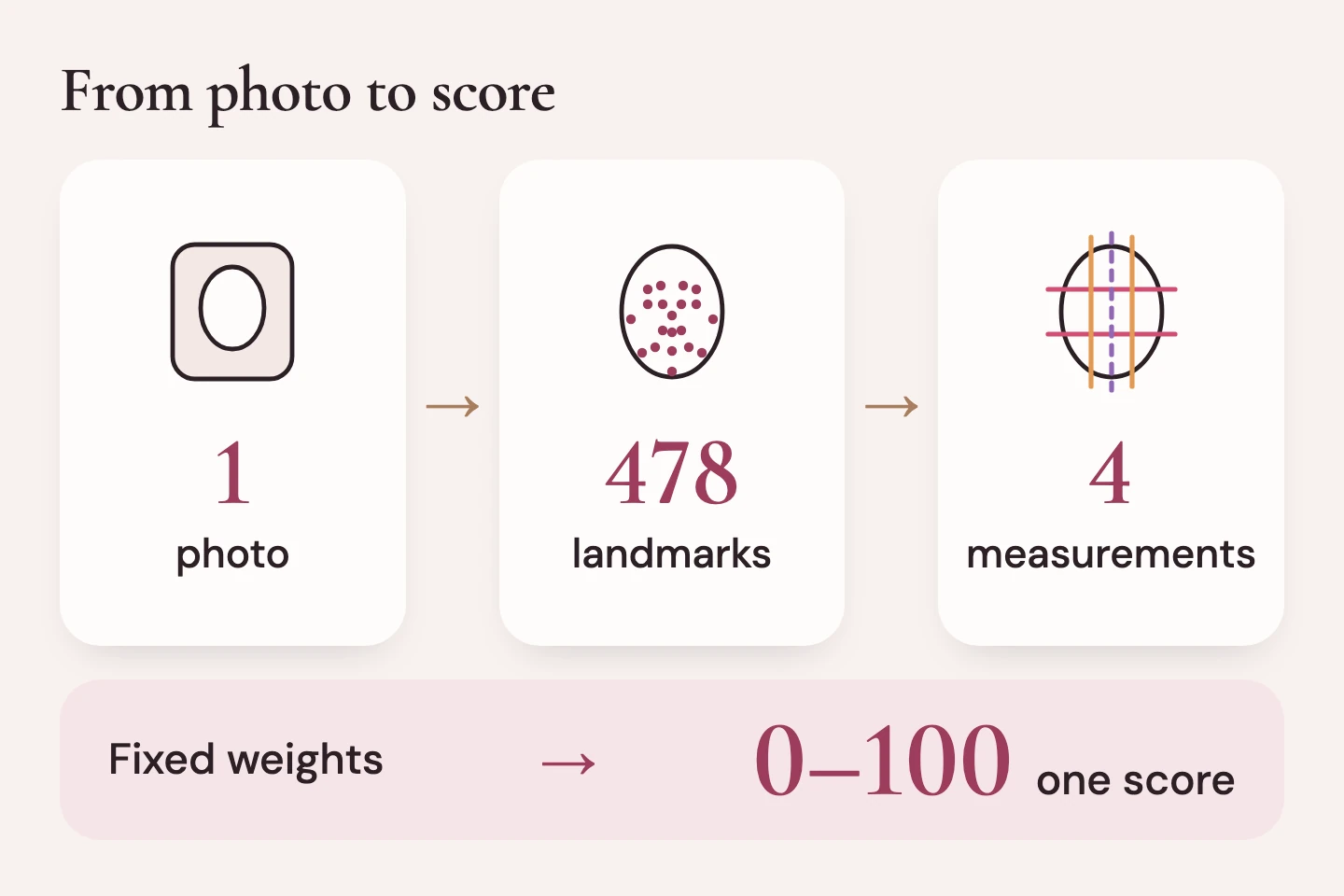
Landmarks. The model marks 478 points on the face in your photo.
Measurements. Distances between those points become ratios: left against right, upper face against lower face, eye width against the gap between the eyes, length against width.
Part scores. Each ratio is compared with a reference value and scored from 0 to 100.
One number. The part scores are combined with fixed weights into the overall result.
Because no language model is asked for an opinion, an AI face rater that works this way gives the same photo the same score every time.
What a face rater measures
Tools differ in what they include. Some add jawline angles, eye tilt or skin, and some keep to proportions. The free FaceStats test scores four parts and shows the weight of each one.
Weight of each part in the FaceStats score
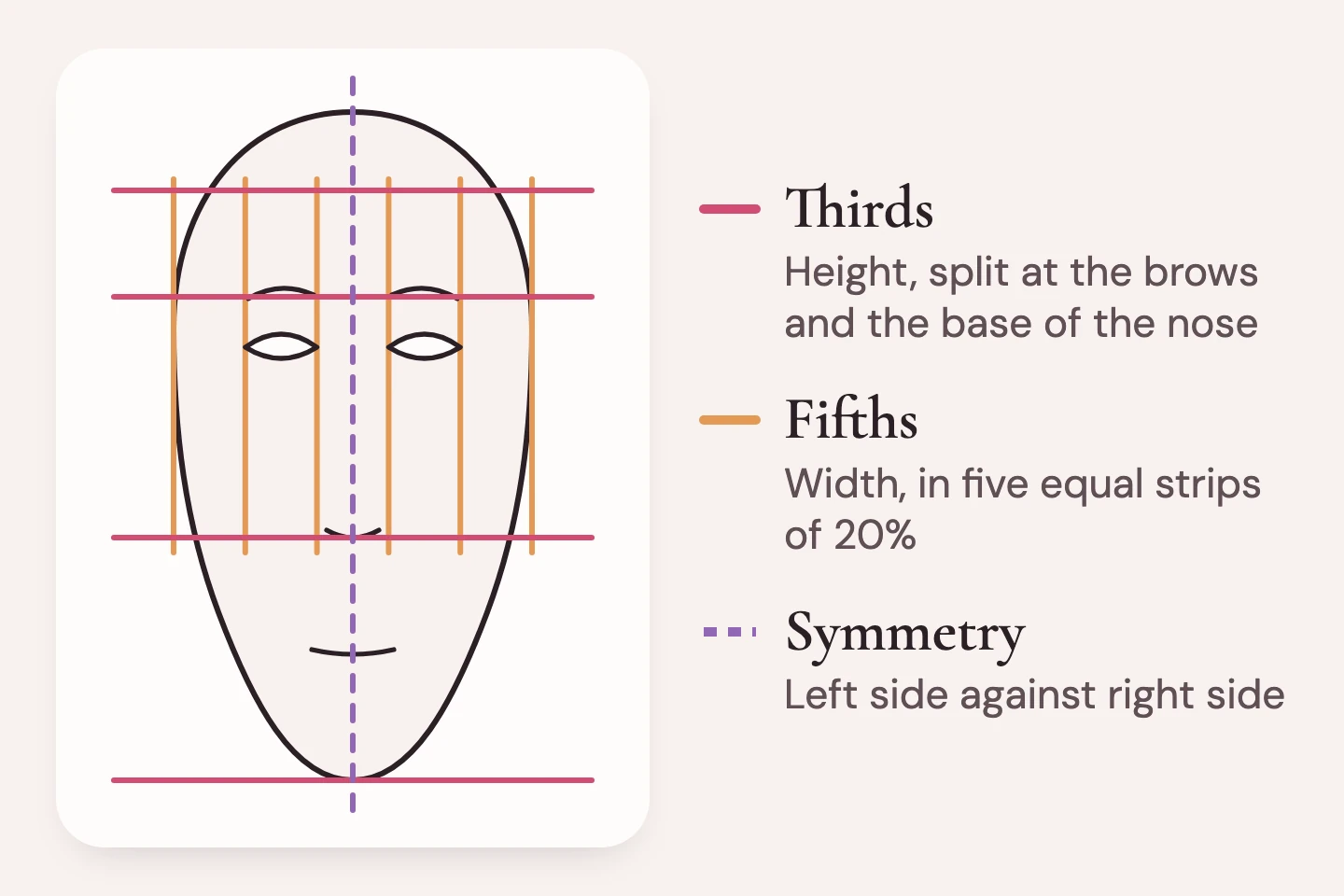
- Facial symmetry (35%). How closely the left and right sides mirror each other. Every 1% of average mismatch takes 5 points off this part.
- Facial thirds (25%). The visible face height, split at the brows and at the base of the nose. The reference puts the mid-face and the lower face at about 41% each.
- Facial fifths (25%). The face width in five vertical strips: the two outer sides, each eye and the gap between the eyes. The reference is five equal strips of 20%.
- Length to width (15%). The golden ratio is 1.618, but landmarks stop below the hairline, so the test compares the visible face with an adjusted target of 1.38.
Face shape, canthal tilt and the midface ratio come from the same landmarks, but they are reported beside the score and do not change it. You can look at single parts on their own in the face symmetry test and the golden ratio calculator.
Face rating scales: what counts as a good score
Most tools report a face rating out of 10 or out of 100. The two scales carry the same information at a different resolution, and converting is simple: divide a 0–100 score by ten. A 72 is a 7.2 out of 10.
FaceStats keeps the 0–100 scale because it shows small differences between two photos that a ten-point scale would hide. Each score lands in one of five bands.
| Score (out of 10) | Band |
|---|---|
| 85–100 (8.5–10) | Exceptional balance. All four parts sit close to their references at once |
| 75–84 (7.5–8.4) | Strong balance. Close in most parts, with only small gaps |
| 65–74 (6.5–7.4) | Balanced. Close overall, with one or two parts clearly off |
| 55–64 (5.5–6.4) | Developing. Several parts sit away from the reference, or the photo pulls them there |
| 0–54 (0–5.4) | Distinctive. Proportions sit well away from the reference averages |
The cut-offs are this tool's own convention; they are experimental, and they measure distance from an average, not appeal. Plenty of striking faces are far from average. Another tool can use a different scale and different cut-offs, so a 7 from one site and a 70 from another are not the same statement.
How to get a free face rating
You need one photo and about a minute. The FaceStats AI attractiveness test is free, runs in your browser and asks for no account.
Take a straight-on photo. Eye level, even light, neutral face. The six rules are in the next section.
Add the photo. JPG, PNG, WebP and HEIC all work. A quality check asks for another photo when the face is blurred, turned or too small.
Read the result. You get a 0–100 score, its band and the four parts with their weights, with the measurement lines drawn on your photo.
Save the card. Download or share a result card. You decide whether it shows your photo.
The photo is measured on your device and is never uploaded for the free test. If you would rather not use a photo at all, the same page has a ten-question version, and its result is marked as self-reported.
How to take a photo for a fair face rating
The test measures the photo, so the photo decides the number. Six habits make the result fair and repeatable.
- Camera at eye level, about an arm and a half away. Held higher, a phone shrinks the jaw and stretches the forehead.
- Face the lens so both ears show equally. Even a small turn changes the fifths and the symmetry reading.
- Soft light from the front. Face a window. Side light makes one half of the face look narrower.
- Neutral face, mouth closed. A smile widens the mouth and lifts the cheeks.
- Nothing over your brows. Glasses, a fringe or a hat hide landmarks the model needs.
- Sharp, with no filters. Rest the phone or use a timer, and turn off beauty mode.
When you retest, use the same spot, the same light and the same distance. Then a change in the score reflects your face and not the camera. The photo rules explain each habit and what the quality check turns down.
Why the same photo gets different face ratings
Upload one picture to three sites and you will often get three numbers. They are measuring different things on different scales.
- Different inputs. One tool measures landmarks, another asks a language model for an impression, and a third averages human votes.
- Different parts and weights. One tool scores jawline and skin, another only proportions, and two that measure the same parts can still weight them differently.
- Different scales. A 6.8 out of 10 and a 74 out of 100 can describe the same face.
- Built-in variation. A chatbot can answer the same question differently each time.
The practical rule is to compare photos inside one tool and never numbers across tools. A measured score with a fixed formula should come back the same for the same file every time. If it does not, treat the number as an opinion.
Can ChatGPT rate my face?
It can try. A chatbot that accepts images will usually describe your photo and attach a number, but that number is an impression and not a measurement. Ask again, or change the prompt, and it can shift. It also means sending your photo to a chat service. For a score you can repeat, use a tool that measures.
How accurate is a face rating?
It is accurate at one job: measuring the geometry in a photo the same way every time. No rating, from any tool, can tell you how attractive other people find you.
| Topic | What a measured score can tell you | What it cannot |
|---|---|---|
| Proportions | How close symmetry, thirds, fifths and length to width sit to fixed references | Whether those references are the right standard for you |
| The photo | Whether the picture was sharp, level and straight enough to measure | How you look in motion or in another light |
| Attractiveness | Which parts of the geometry are balanced | How people respond to your expression, style, voice and presence |
Studies of attractiveness ratings tend to point to symmetry, closeness to typical proportions, clear skin and signs of health, but each effect is modest and taste varies widely.
Be wary of anything sold as a "brutally honest" face rater. Harshness is not accuracy. A tool is honest when it shows what it measured, the weights it used and the limits of the result.
Can you improve your face rating?
Yes, mostly by changing the photo, because your proportions stay the same from one day to the next.
- Fix the photo first. Eye level, straight on, even light and a neutral face. The same face gains or loses points with the camera alone.
- Choose a cut for your face shape. A haircut can add width where a face is narrow, or length where it is wide. The face shape calculator finds your shape, and the face shape and hairstyle guide shows what balances each one.
- Groom your brows and look after your skin. Evenly shaped brows make the eye area read as more balanced, and sleep, sunscreen and a simple routine show in every photo.
Styling changes how a face reads to other people more than it changes the measured number, and that is fine. Every idea here is healthy and easy to undo.
Face rating FAQ
Is a 7.5 face rating good?
Yes. A 7.5 out of 10 equals 75 on the 0–100 scale, which is the start of the Strong balance band on FaceStats, the second highest of five. Other tools set their own cut-offs, so check the scale of the tool that gave you the number.
Is a 78 face score good?
Yes. On FaceStats a 78 sits in the Strong balance band, which runs from 75 to 84. It means most measured parts are close to their references. The breakdown shows which part held the total back, and a retake at eye level shows whether the camera played a role.
How do I get my face rating for free?
Open the FaceStats test, add one front-facing photo and read the result. The score, the band, the four-part breakdown and the share card are all free, with no account and no email. An optional paid report goes further, but the free test never requires it.
What is the best face rating website?
Look for four things instead of a brand name. The site shows its formula. The same photo always gets the same score. The photo is measured on your device, or you can delete it. The basic result is free without sign-up. FaceStats is built to meet all four.
What is the most accurate face rater?
No face rater can measure attractiveness itself, because people disagree about it. What a tool can do accurately is measure geometry. The most trustworthy ones read the same landmarks with the same formula every time, publish their weights and say plainly what the score does not cover.
Can I rate my face out of 10?
Yes. Take your 0–100 score and divide it by ten, so a 68 becomes 6.8 out of 10. The 100-point scale stays because it shows small differences between two photos that a ten-point scale would round away. The same photo always converts to the same figure.
Get your free face rating
A score is most useful when you know what went into it. Take one clear, straight-on photo and get your free face rating with the FaceStats test: a 0–100 score, the four measured parts and a card to share, in your browser with no sign-up.