Am I ugly? How to get an honest answer
Am I ugly? Mirrors, selfies and bad days all mislead. See why you look worse on camera, what a face score can and can't say, and when to talk to someone.
Nobody can settle "am I ugly?" as a fact, because ugly isn't something a face has in the way it has a width or a length. What you can find out is how your face reads in a fair photo, and whether the fear comes from your looks or from the way you've been checking them. This guide covers why mirrors and selfies mislead, what a test can and can't tell you, and what helps when the feeling won't let go.
Am I ugly, or do I just feel ugly?
These are two questions, and they need different answers. "Am I ugly or attractive?" is about how other people see you. "I feel ugly" is a report on your mood, your week and what you've been looking at. A thought like "I'm ugly" often arrives with tiredness, a breakup or an hour of scrolling, then fades, although your face hasn't changed at all.
Looks also don't sort into two boxes. When strangers rate faces, most ratings bunch around the middle, few land at either end, and raters disagree a lot about any one person. So a more useful version of "how ugly am I?" is "how does my face come across, and to whom?" Our am I pretty guide looks at the same question from the hopeful side.
People who know you also see your expressions and hear your voice, and research on familiarity suggests that people tend to look better to us once we like them. If you're asking "am I unattractive?" after one bad photo, nobody who knows you has only that photo to go on.
Why do I look so ugly on camera?
You look different on camera because a photo changes your face in ways a mirror doesn't. Four things do most of the damage.
Your mirror face is flipped
The face you know best is a reversed one. You've seen it that way every day of your life, so it feels right, and in a photo every small asymmetry lands on the wrong side. Studies of this effect have found that people tend to prefer their own mirror image, while their friends prefer the unflipped one.
A close lens enlarges what is nearest
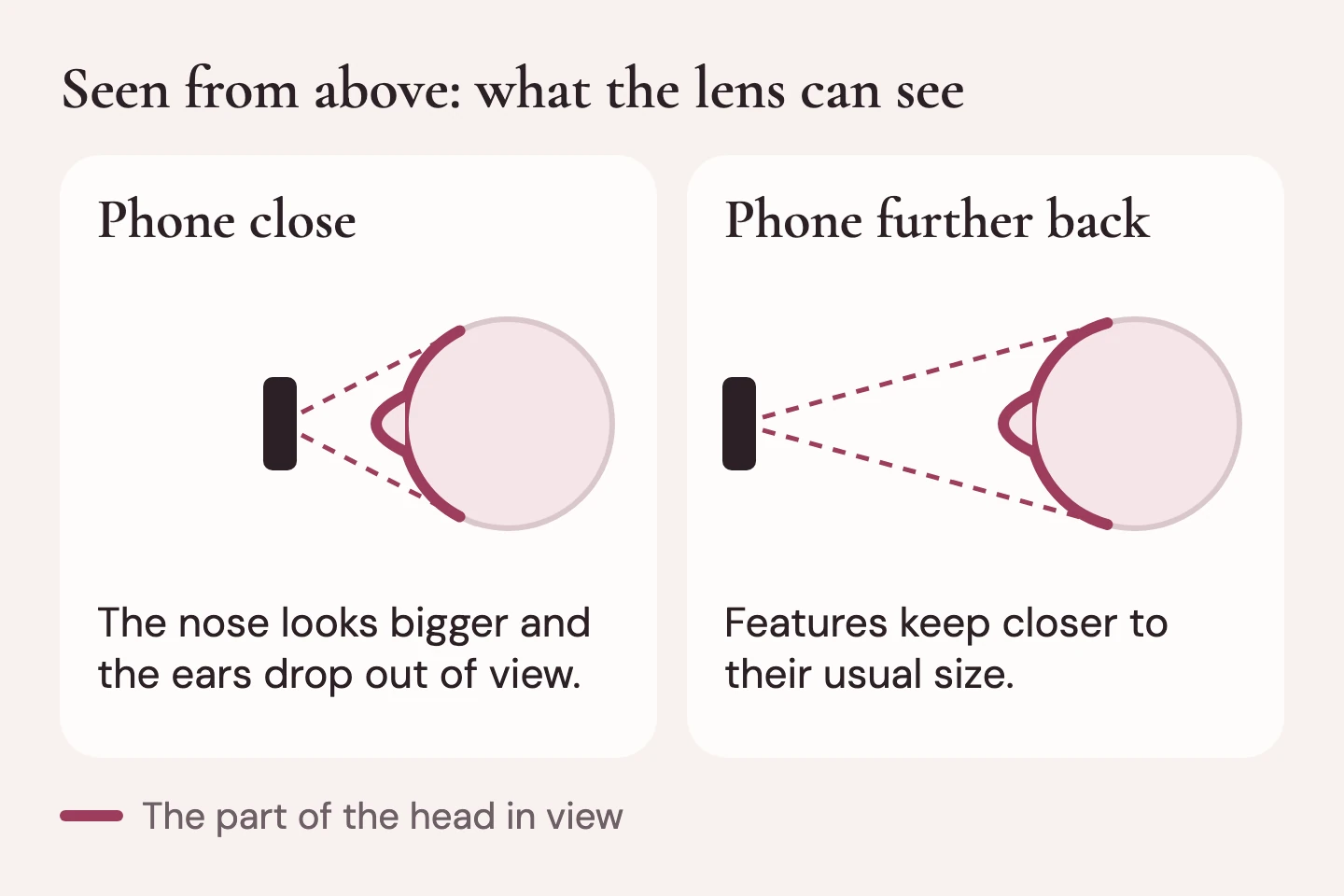
A phone at arm's length sits very near your face. Whatever is closest to the lens, usually the nose, looks bigger, while the ears and the sides of your face fall away. Move the camera a few feet back and the same face looks calmer through the middle. That makes a selfie about the worst evidence you can bring to this question.
Hard light draws lines you don't have
Overhead light puts shadows under your eyes and nose. Bathroom bulbs and phone flash flatten some features and exaggerate skin texture. Turning to face a window evens all of that out.
A frozen face isn't your face
Other people see you moving. A photo picks a fraction of a second, often mid-blink or mid-word, and then you judge it for minutes. When you think "I look ugly" in a candid shot, the shutter may simply have caught you between two expressions.
So the next time you ask "why do I look so ugly?", check the distance, the light and the moment first. Our photo rules show the setup that gives a face its fairest picture.
How to know if you are ugly: the evidence that misleads
Most of what people use to work out how to tell if you're ugly is weak evidence, because each sign has a simpler explanation.
| What feels like proof | Why it misleads |
|---|---|
| Nobody compliments your looks | Most adults rarely comment on each other's looks, whatever they think |
| You're single | Timing, shyness and who you meet count for a lot |
| Someone called you ugly | One remark, often meant to hurt, is not a survey |
| People glance at you or look away | Most glances are habit, and you read them at your most anxious |
| You don't look like people online | Those pictures are chosen, lit and often edited |
Psychologists have a name for part of this: the spotlight effect. We overestimate how much other people notice about us, so a feature that fills your mirror may barely register with anyone else. A kind word from your mom doesn't settle the matter either. No single sign does.
Why am I so ugly? What is usually behind the thought
The thought "why am I so ugly?" usually comes from how you've been looking, more than from what you look like. If you keep asking "why am I ugly?" or "why do I feel so ugly?", one of these is often underneath.
- Comparison. Your feed shows the top of a heavily selected pile, much of it filtered. An ordinary face looks worse beside it.
- Zooming in. Stare at one feature for long enough and it stops looking like part of a face.
- Mood. Stress, poor sleep, anxiety and low mood all make self-judgment harsher.
- Old words. A nickname or a bully's line from school can keep running for years. If you've ever wondered "why was I born ugly?", ask who first put that idea in your head.
- A face still changing. If you're a teenager, your face is still growing and its proportions are still shifting. Nothing you see in a photo today tells you how you'll look in a few years, so the test isn't for you yet.
Am I ugly test, quiz, Reddit or AI: what each can tell you
Each route answers a smaller question than the one you're really asking.
| Where you ask | What you actually learn |
|---|---|
| An am I ugly quiz | Your own opinion handed back to you, since the answers are yours |
| Am I ugly Reddit threads | How a few strangers reacted to one photo, and some of them are cruel |
| An am I ugly AI chatbot | A polite paragraph that can change when you ask again |
| A rating app or ugly test | Whatever its maker built in, and many never say how the number is made |
| A measured face test | How one photo's proportions compare with fixed references, repeatably |
| A blunt friend or hairdresser | Practical notes from someone who sees you in motion |
If you're curious how your proportions measure up, a measured test does that. If you want to feel better, none of these will do it, and the steps further down are a better use of your time.
What a face score can and can't say
A face score is a measurement of one photo, not a verdict on you. The free AI attractiveness test on FaceStats places 478 landmarks on your face, reads facial symmetry, facial thirds, facial fifths and your length-to-width ratio, then combines them into a 0–100 score and names your strongest and weakest part. The photo stays in your browser, you don't need an account, and it's for adults 18 and over. Ten questions give a self-reported version if you'd rather not use a photo.
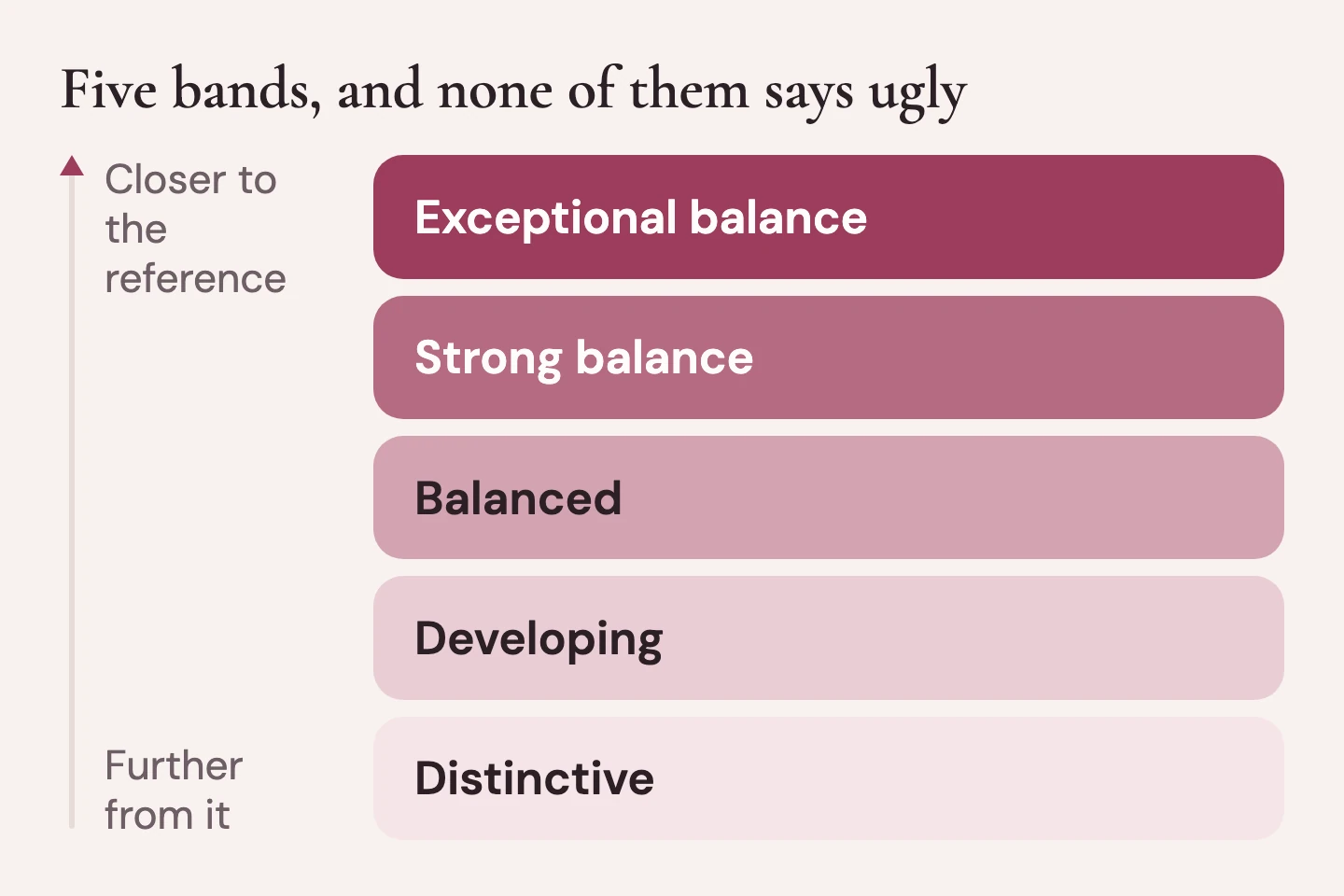
There is no ugly band here, and no honest ugly scale exists anywhere else. Our five bands run from Distinctive to Exceptional balance. Plenty of striking faces sit far from the reference proportions, and a lower number can come down to the camera. Our guide to face ratings explains the bands in detail. Every real face also has some facial asymmetry, and most of it needs no fixing.
The score can't see your skin, hair, style, expression, voice or warmth, and it knows nothing about how anyone feels when they're with you.
Take the test if you're curious and can hold the number lightly. Skip it if you're feeling low, if you'd read any result as proof of what you already fear, or if you've been testing and comparing photos again and again. More checking tends to feed the worry, whatever the number says.
How to stop feeling ugly
Learning how to stop feeling ugly starts with less checking, not with a different face. You don't have to decide you're beautiful.
Cut the checking. Give mirrors and photos one look to get ready, then leave them. Each extra check keeps the worry alive.
Clean up your feed. Notice which accounts leave you feeling worse, then unfollow or mute them.
Talk back to the thought. When "I am ugly" or "I hate being ugly" shows up, call it a thought rather than a fact. Then ask what you'd say to a friend who said it about themselves.
Change what you can. A haircut that suits your face shape, sleep, a simple skin routine and clothes that fit are all within reach.
Spend time where looks aren't the point. Sport, music, friends and work you care about pull your attention outward.
How to deal with being ugly, or with the fear of it, is less about winning the argument and more about giving it a smaller share of your day.
When to talk to someone
Talk to a doctor or a therapist if thoughts about your looks take up much of your day or keep you from your life. Body dysmorphic disorder (BDD) is a mental health condition in which someone is preoccupied with flaws that others barely see or don't see at all. It isn't vanity, and it can be treated. Signs include:
- You check mirrors and photos over and over, or avoid them completely.
- You hide a feature, or skip school, work or seeing people because of it.
- You keep asking people, or the internet, "am I ugly?" and no answer lasts.
- You're considering a procedure to fix something others say they can't see.
- You feel ashamed or hopeless because of how you look.
"I think I'm ugly" on its own isn't a diagnosis. A family doctor is a good first stop, and talking therapy such as cognitive behavioral therapy has solid support for this kind of problem. If you're under 18, tell a parent, a school counselor or another adult you trust. If you're thinking about ending your life or hurting yourself, call or text 988 in the US or your local emergency number now.
Am I ugly FAQ
How do I know if I am attractive or ugly?
You can't get a final answer, because attractiveness depends on who's looking. A fair photo, a measured test and honest friends each show one part of the picture. If people treat you normally and nobody around you sees the flaw you fear, trust that over a bad selfie.
Am I uglier than I think?
It can go either way, and nobody is a reliable judge of their own face. Studies find only a loose link between how attractive people rate themselves and how strangers rate them. People who worry about their looks tend to be harsher on themselves than anyone else is, so a low opinion is weak evidence.
What makes you look uglier in photos?
Mostly the setup. A phone held close makes your nose look bigger, overhead light puts shadows under your eyes, and flash flattens your features. A camera held high or low changes your proportions, and a stiff expression does the rest. Move the camera back, keep it at eye level and face a window.
Can AI tell me if I'm ugly?
No. AI can measure distances on a face or write an opinion, but neither one settles it. A chatbot like ChatGPT usually gives a gentle reply that can change when you ask again. A measured test repeats the same number for the same photo, yet that number describes proportions, not your looks as a whole.
Is an am I ugly test accurate?
It can be accurate about geometry and still say nothing about ugliness. A good test reads the same landmarks the same way, so one photo always gets one result. No test can measure how people feel when they see you, so treat any result as a note about one picture, not a fact about you.
Am I pretty or ugly?
Most faces are neither. "Am I pretty or ugly?" offers two boxes, while real faces spread across a wide middle where personal taste decides a lot. A tool that answers with one of those two words is selling a simple story. Ask what suits your face instead, because that question has useful answers.
What to do next
If you're curious and feeling steady, take one clear photo at eye level and answer "am I ugly" with a measurement instead of a mood. You'll get a free 0–100 score and the four parts behind it, in your browser, with no sign-up. It's for adults 18 and over. Read it as a note about one photo. If you're not feeling steady, close this tab and message someone you like.