Pretty scale explained: is your score accurate?
A pretty scale turns face proportions into one score. See how the test works, what 60 or 75 really means, why it misleads and how to check yours free.
A pretty scale is an online test that turns the proportions of your face into one score, usually out of 100. It measures distances in a single photo and compares them with fixed reference numbers, so it can show how that photo fits those numbers. It can't tell you how pretty you are. This guide explains how a pretty scale test works, what each score range means, why the best-known test never shows a low score, and how to get a fairer reading.
What is the pretty scale?
The pretty scale is two things: a general name for face beauty tests, and a website. PrettyScale.com is the best-known version and takes the largest share of search clicks for the term. Photo editors and AI apps now use the name as well, so a search for "pretty scale" or "prettyscale ai" turns up many tools that work in very different ways.
Most of them fall into three groups:
- Line tests. You place marks on your photo and a formula does the rest. PrettyScale works this way.
- Landmark tools. Software finds the points on your face and measures them for you.
- AI impressions. An app or chatbot returns a number without showing how it got there.
A pretty calculator, a beauty scale and an am i pretty quiz are usually the same idea under another name. Some quizzes skip the photo and score your answers instead.
How a pretty scale test works
These tests compare ratios. They don't look at your face the way a person does. Here is what happens in PrettyScale's face test, taken from the public script it loads in your browser, as read in November 2026.
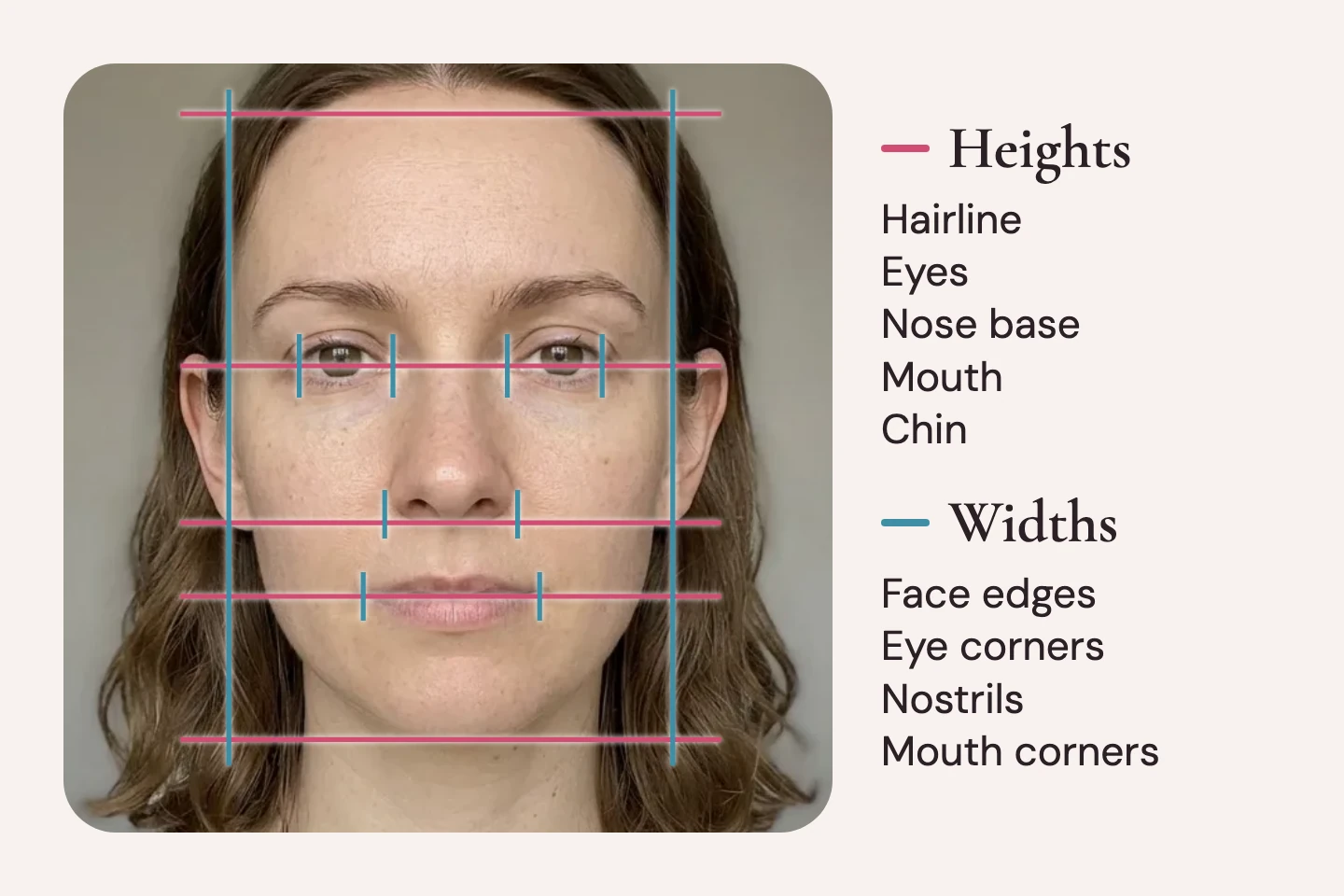
You place the marks. Fourteen prompts ask you to line up marks on your eye corners, chin, face edges, hairline, nose and mouth.
Distances become ratios. The marks give eight ratios, such as face width to face height and mouth width to nose width.
Each ratio meets a target. There is one set of reference values for women and one for men.
Closeness is rounded down. A ratio 4% off its target keeps 96 points. A ratio 5% off drops to 75.
Penalties come off. The eight results are averaged, then points are taken away for lip position, eye spacing and symmetry.
What the test measures
PrettyScale's help page lists face shape, the distance between the eyes and lips, mouth size and face symmetry, with the golden ratio used at times. The feedback in its script also comments on forehead size, eye spacing, nose width and chin size. All of it comes from straight-line distances, so skin, hair, expression and the way your face moves play no part.
Pretty scale scores: what each range means
On PrettyScale, 60 is where the verdict reaches "good looking" and 75 is where it reaches "pretty". The ranges below come from its script. They are one site's labels and not a shared standard.
| Score | PrettyScale's verdict |
|---|---|
| Below 45 | Never shown |
| 45–59 | Not bad |
| 60–74 | Good looking |
| 75–89 | Pretty |
| 90–96 | Beautiful |
| 97–100 | Almost perfect |
Why you never see a low score
PrettyScale never displays a score below 45. Each time the page loads, the site picks a random floor between 45 and 50, and any lower result is lifted to that number before you see it. The harsher verdicts are still in the code, but the floor keeps them from appearing.
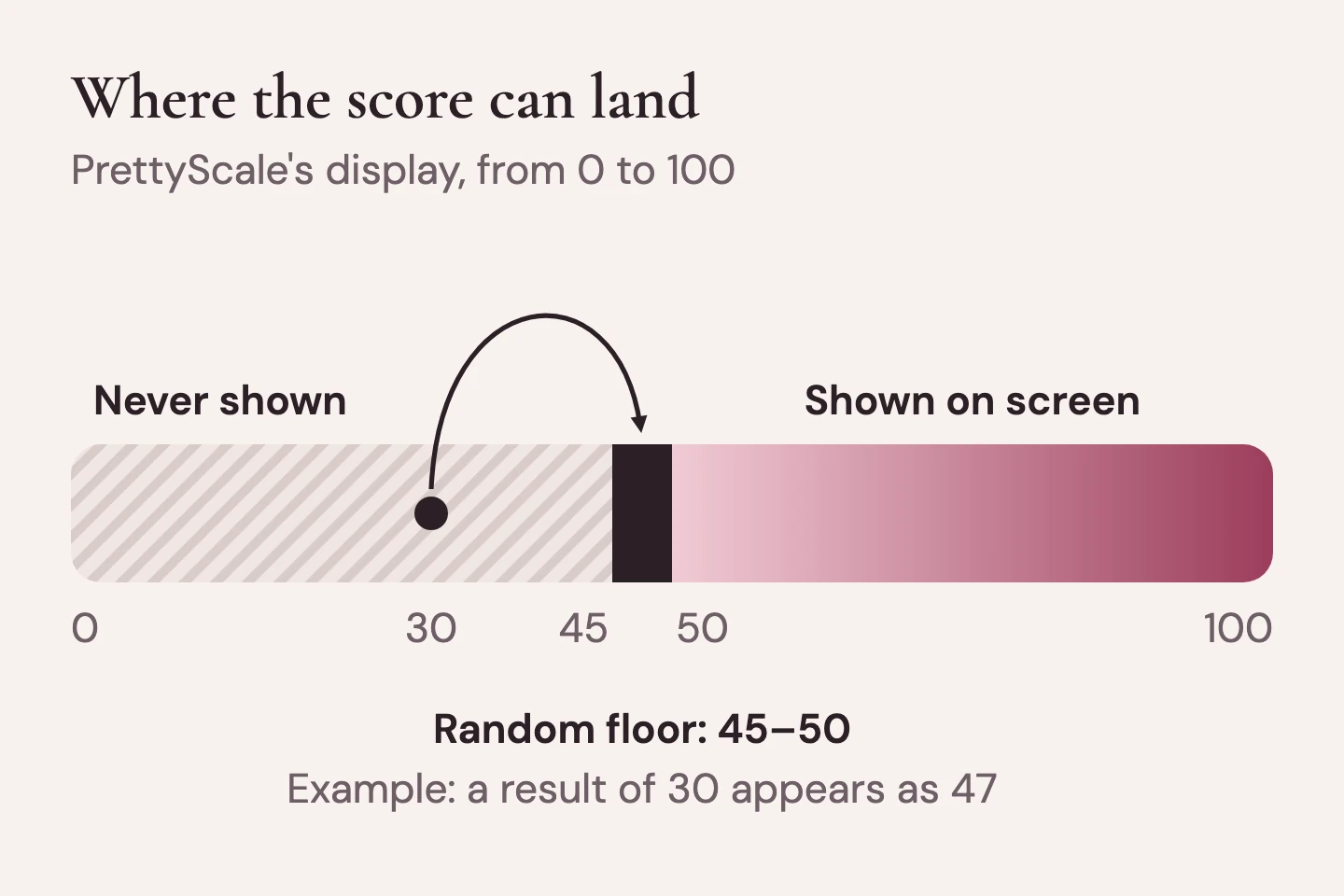
So a 47 can be a real 47 or a much lower result in disguise. At that end of the scale the number tells you almost nothing.
What is the average on the pretty scale?
No average has been published, and the number is not a percentile. A 70 doesn't mean you beat 70% of people. It only says how close eight ratios came to one set of targets. The rounding also bunches results together: a face sitting 5% from every target would land on exactly 75 before penalties, the first score in the "pretty" band.
Pretty scale out of ten
Divide by ten for a rough score out of ten, so 75 becomes 7.5. Each tool sets its own cut-offs, though, so the same figure can carry a different label elsewhere. On FaceStats, 75 starts the strong balance band, and our guide to face rating scores explains how those bands work.
Is the pretty scale accurate?
The pretty scale is accurate as arithmetic and weak as a verdict on your looks. The formula gives the same answer for the same marks, but three things limit what that answer means.
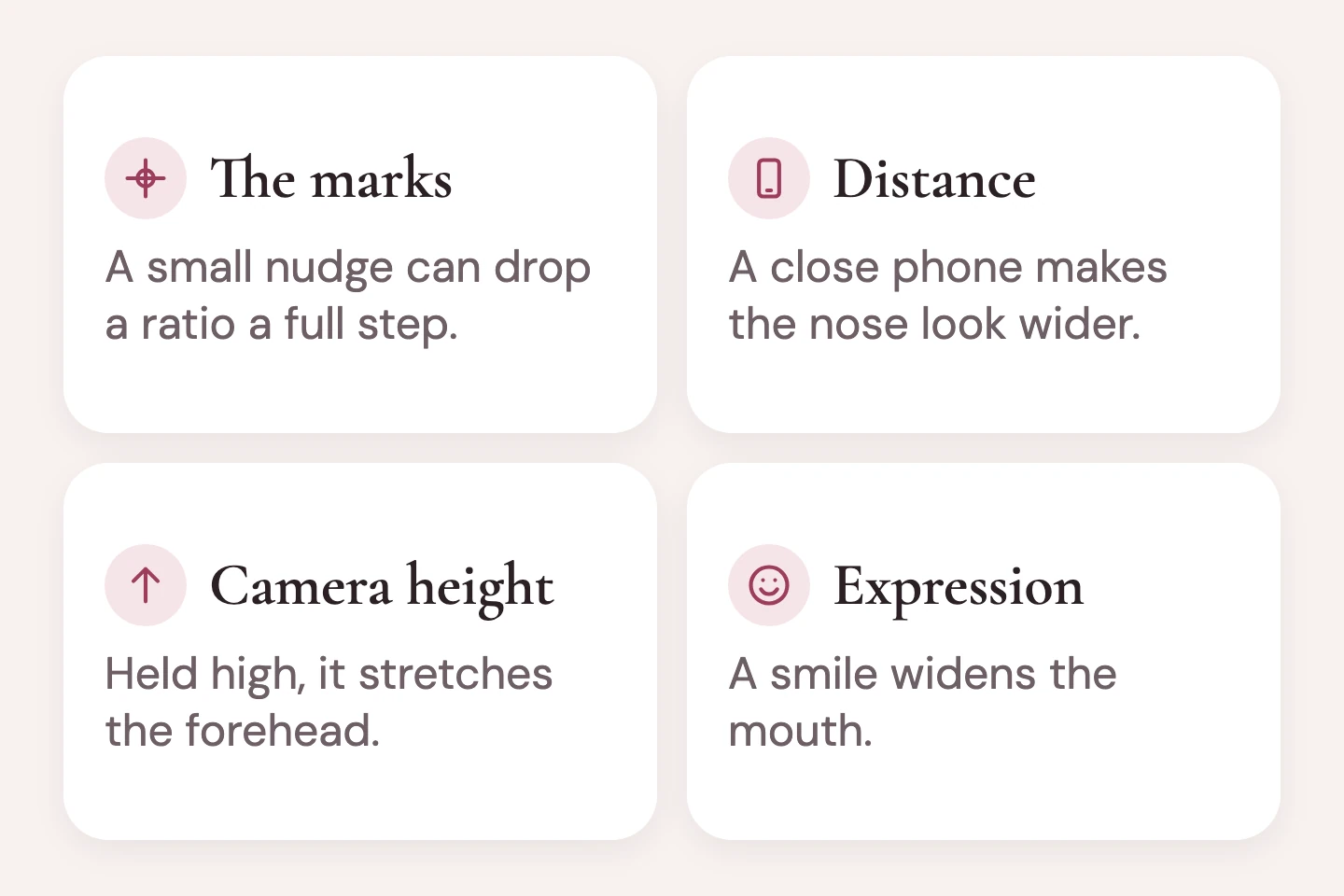
- The marks are placed by hand. PrettyScale's help page says results can differ with how you place the lines and dots. A small nudge can matter: a ratio that slips from 4% to 5% off loses 21 points, which moves the final score by nearly three.
- The targets have no stated source. The reference values are fixed numbers with no study cited, and the homepage itself says results could be incorrect.
- The photo changes the proportions. A phone held close makes the nose look wider, and a camera above your eyes stretches the forehead and shrinks the jaw. A smile widens the mouth, and the test itself asks for a straight face.
So how realistic is the pretty scale? It is realistic as a piece of geometry and not as a picture of how people see you. Research links facial symmetry and average proportions with attractiveness, but only in part. People also differ a lot in what they like, and they judge faces in motion, with expression, voice and familiarity. No single ratio has been shown to define a beautiful face.
Is PrettyScale safe to use?
PrettyScale's privacy policy says images stay on your device unless you choose to download or share them, and that a picture shared to some social sites may pass through its servers without being stored. We have read that policy but not audited the site. It does show third-party ads and use cookies.
The homepage also asks people with low self-esteem or confidence issues not to start, which is sound advice for any test of this kind. Use only your own photo, and check where it goes before you upload it.
Am I pretty? What a score can't tell you
No test can answer "am I pretty", because prettiness is a judgement people make and not a property a ruler can find. A scale reads one still photo. The people who know you read a moving face, with its warmth, its humour and the way it changes when you laugh.
If you are asking "how pretty am I" or "how beautiful am I", it helps to work out what you really want to know:
- To understand your features, a measurement helps. Look at the parts, not the total.
- To learn how you come across, ask a friend whose taste you trust, or look at candid photos of yourself mid-laugh.
- For a bit of fun, an am i pretty test is fine. Take it once, then close the tab.
How to get a fairer reading
A fairer pretty scale reading comes from the same photo conditions each time and from software that places the points for you. Start with the photo:
- Face a window, so soft light falls evenly on both sides.
- Hold the camera at eye level, about an arm and a half away.
- Look straight ahead with a neutral face, mouth closed and hair off your brows.
- Turn off filters and beauty modes.
- Take two or three photos and compare them inside one tool.
Our six photo rules explain why each of these matters.
Automatic measuring removes the biggest source of drift. The FaceStats attractiveness test finds 478 points by itself, so the same photo always gets the same result. Its method differs from PrettyScale's:
- Score. A 0–100 result from four parts: symmetry (35%), facial thirds (25%), facial fifths (25%) and the golden ratio (15%).
- No hidden floor. You see the number the formula gives, low or high.
- Privacy. The free test runs in your browser, so your photo stays on your device. There is no sign-up.
- Limits. It still measures one photo against fixed reference values, and its bands are experimental. It can't say how attractive other people find you either.
Don't compare a FaceStats score with a PrettyScale score, because they measure different things. To look at one part on its own, try the face symmetry test or the golden ratio calculator.
Pretty scale FAQ
What is the pretty scale?
It is a general name for online tests that score a face from one photo, and also the name of the best-known one, PrettyScale.com. These tests turn distances between facial features into ratios, compare them with fixed targets and return a number, usually out of 100.
Is the pretty scale accurate?
It is accurate as arithmetic but not as a judgement of your looks. The formula is consistent, yet hand-placed marks, the photo and reference values with no stated source all shape the result. Read a score as one photo measured against one site's targets, and nothing more.
What is a good score on the pretty scale?
On PrettyScale, 60 earns "good looking", 75 "pretty" and 90 "beautiful". Those labels belong to one site. Other tools set different cut-offs, so a good score on one test may mean little on another. Scores also move with the photo, so treat small differences as noise.
What is the average on the pretty scale?
No average is published, and the score is not a percentile. It shows closeness to fixed targets, not your place among other people. PrettyScale also lifts low results to a random floor between 45 and 50, so any average worked out from displayed scores would run high.
Can AI tell me if I'm pretty?
AI can measure your proportions or offer an impression, but it can't settle whether you are pretty. That judgement belongs to people, and they disagree. Treat an am i pretty AI tool as a description of one photo. Measuring tools are steadier than chatbots, which can change their answer.
Is PrettyScale safe?
Its privacy policy says images stay on your device unless you choose to download or share them, and that shared pictures are not stored. It does show third-party ads and use cookies. We have not audited the site. Use only your own photo, and stop if the result upsets you.
Is 7.5 out of 10 good for looks?
On the scales covered here, yes. A 7.5 equals 75 out of 100, where both PrettyScale's "pretty" band and the FaceStats strong balance band begin. It still describes one photo on one tool's scale, and a different photo or tool can give a different number.
Can ChatGPT rate how pretty I am?
It can describe a photo and offer a number, but that is an impression and not a measurement. Ask twice and the answer can change, and your photo goes to a chat service. For a number you can repeat, use a tool that measures fixed points with a fixed formula.
Try a free alternative
A number is only useful when you can see what went into it. Take one clear, straight-on photo and try this free pretty scale alternative: a 0–100 score, the four measured parts and a card to share, in your browser with no sign-up. Use it to learn about your proportions, and leave the question of how pretty you are to the people who know you.