Am I pretty? How to get an honest answer
Am I pretty? No photo test can settle it, but you can get a fair answer. See why mirrors and selfies mislead you and what a free face test really shows.
Am I pretty? If you typed that into a search bar, you probably wanted a plain answer, so here it is: no photo, quiz or stranger can settle it, because beauty is part shared taste and part personal taste. What you can get is a fair read. This guide shows why your own eyes are a poor judge of your face, which signals deserve some trust, what a free photo test can and can't tell you, and what to do when the question starts to hurt.
Am I pretty? The short answer
It depends on who is looking, and that is not a dodge. Research on face preferences suggests that roughly half of what one person finds attractive is shared with other people, and the other half is their own. The shared half leans toward things like healthy skin and balanced features. The personal half comes from experience: the faces you grew up with, the people you have loved, the looks your friends admire.
So one big question is really three smaller ones, and each has a different judge.
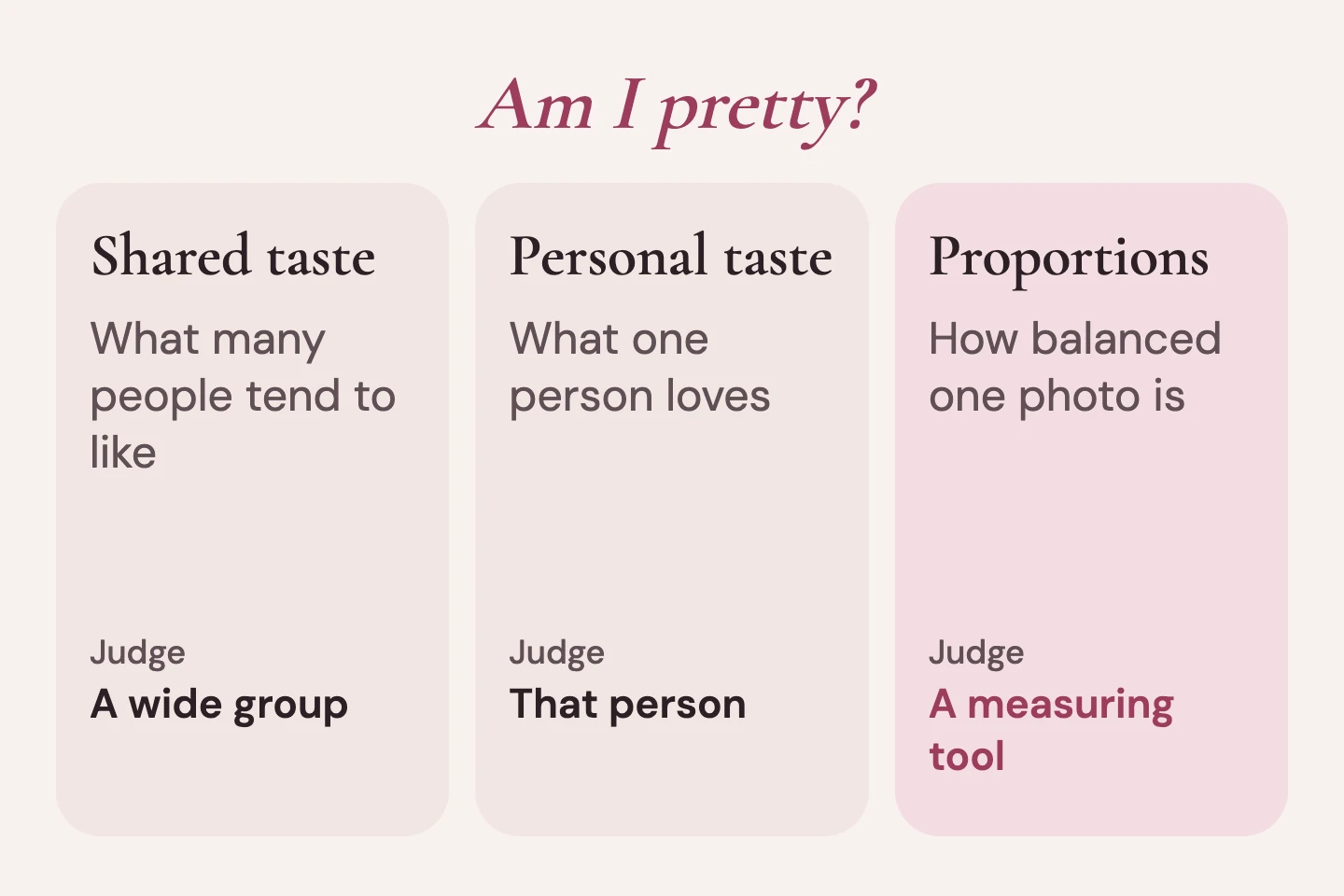
Only the third question has a number behind it, and it is far narrower than the word "pretty". Still, a measurement has one thing opinions lack: you can repeat it and see how it was made.
Why you can't judge your own face
You have the worst seat in the house. You have looked at your face thousands of times, usually up close and usually hunting for something to fix, so small details nobody else notices become the first thing you see.
When researchers compare how people rate their own looks with how others rate them, the two scores match only loosely. That does not mean you always see yourself as worse than you are. Some people rate themselves too low, others too high, and the gap can run either way. It does mean a bad morning in front of the mirror tells you very little.
Comparison makes it harder: most faces online were picked from many shots, then edited or filtered, so your everyday face is up against someone else's best picture.
Why am I pretty in the mirror but ugly on camera?
This has two ordinary explanations, and neither is about your face.
The mirror is the version you know. A mirror flips your face left to right, and that flipped face is the one you see every day. In a classic psychology experiment, people preferred a mirror-flipped picture of themselves, while their friends preferred the unflipped one. We tend to like what is familiar, so a normal photo looks slightly wrong to you and perfectly normal to everyone else.
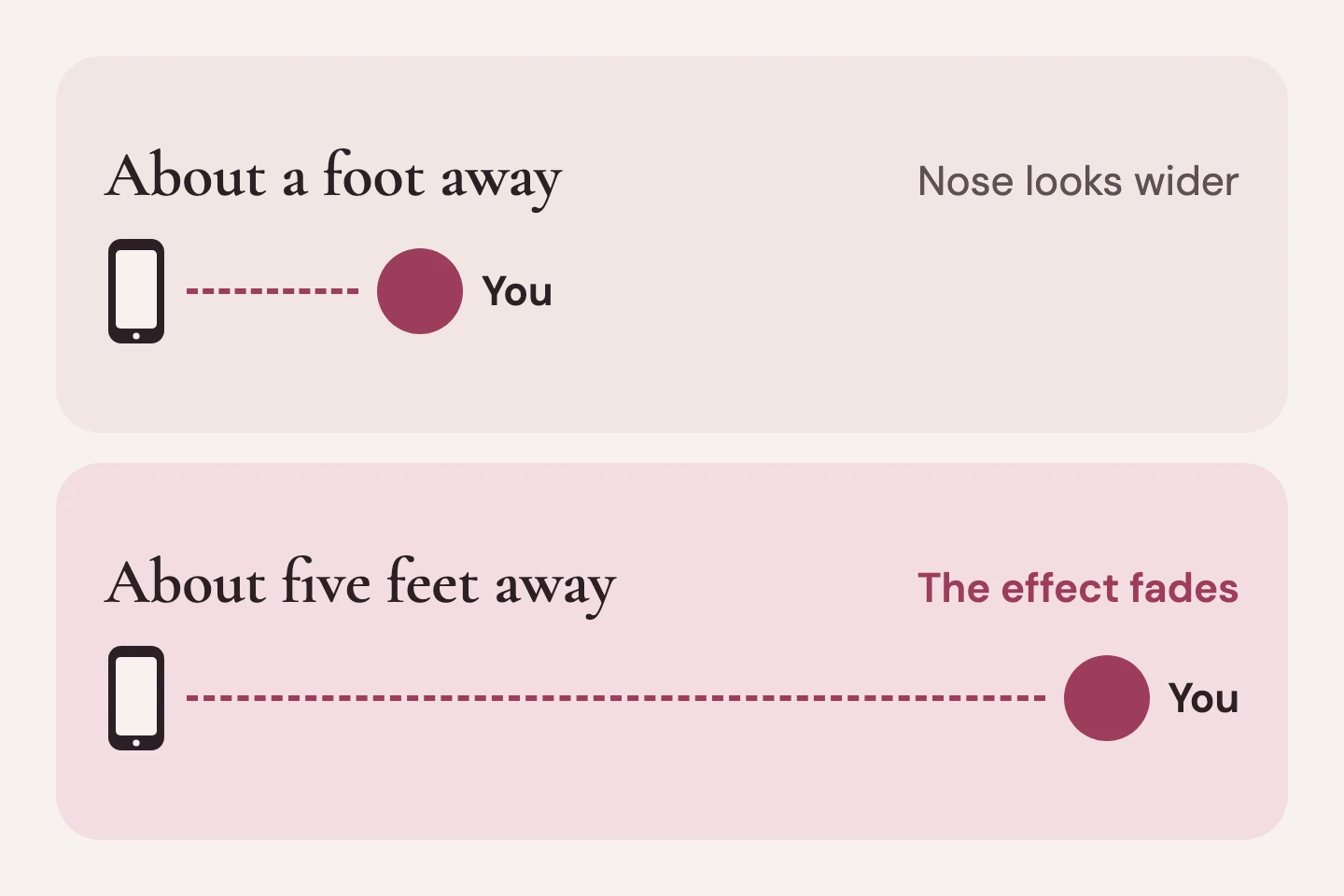
A close camera changes the picture. A study of selfies found that a camera about a foot from the face makes the nose look noticeably wider, and that the effect fades by about five feet. Whatever sits nearest the lens looks bigger, while the ears and jaw fall back.
Neither one is the real you. The nearest thing to how others see you is a photo someone else takes from a few feet away in daylight, and even that freezes a face people normally see moving.
How to know if I am pretty
The best evidence comes from real people, over time, in ordinary life. One comment or one photo proves very little, and some popular signals prove almost nothing.
| Worth some weight | Worth very little |
|---|---|
| Compliments from different people, over months | One comment from a stranger, good or bad |
| Friends choosing candid photos of you | Likes and views on a single post |
| Photos others take from a normal distance | Selfies at arm's length from one angle |
| People with nothing to gain saying it unprompted | Being stared at, which has many causes |
Online lists of signs that you are secretly beautiful lean heavily on that last row, but people look at each other for all kinds of reasons.
Asking a friend works better if you change the question. "Do I look good?" invites kindness, and "Is my face good looking?" puts them on the spot. Try "Which of these two photos looks most like me on a good day?" That gets you an honest answer you can use.
Am I pretty quiz, test or AI: which to trust
Several kinds of tool answer this search, and they do not measure the same thing. Before you trust a result, check what went into it.
| Tool | What it really tells you |
|---|---|
| Am I pretty quiz | How you already see yourself, because your own answers go in |
| Chatbot or am I pretty AI opinion | A verdict in words, which can change when you ask again |
| Forum or rating site | How a few strangers reacted to one picture |
| Measured photo test | How balanced the proportions are in one photo |
None of these can see your warmth, your voice or your style, which is much of what makes someone lovely to the people who know them. The measured test is the narrowest of the four, and that is why it is the easiest to check: it applies one formula to fixed distances, so the same photo gets the same score.
How pretty am I photo test: how to take it
A photo test is only as fair as the picture you give it. Four steps get you a result worth reading.
Take one clear photo. Camera at eye level, about an arm and a half away, facing a window, with a neutral face and no filters. The six photo rules cover the details.
Upload it. The AI attractiveness test runs in your browser, so the photo stays on your device. There is no sign-up and no payment.
Read the breakdown. You get a 0–100 score and a band, plus four readings: facial symmetry, facial thirds, facial fifths and the golden ratio.
Repeat before you believe it. Take a second photo the same way. A tilt or a low camera can move the number, so one result is only a first look.
The test is for adults aged 18 and over, and for photos of yourself or of another adult who has agreed. If you are younger, it is not for you yet, and talking with an adult you trust will help far more than a number could. If you would rather not upload anything, the same page has a ten-question version, marked self-reported because it reflects how you see your own face.
What your score can and can't tell you
A score tells you how close the proportions in one photo sit to a set of reference values. The same measurements apply to every face, so the score describes geometry rather than one group's beauty ideal. The bands are the tool's own convention, not a ranking of people.
| A score can tell you | A score can't tell you |
|---|---|
| Which of the four readings is strongest and weakest | Whether someone will find you beautiful |
| Where your thirds and fifths sit against the reference | How you look when you talk, laugh or move |
| How much a better photo changes the result | What your hair, skin and style add |
| Whether two photos taken the same way agree | What you are worth |
To see what a given number means, read our guide to face ratings. If the two sides of your face are what worries you, the face symmetry test looks at that alone, and our guide to facial asymmetry explains why a little of it is normal.
Am I pretty or ugly? When the question hurts
"Am I pretty or ugly?" is rarely a question about geometry. It often follows a breakup, a cruel comment or a long night of scrolling. It also offers only two answers, and almost nobody fits either: most people look wonderful in some light, to some people, and ordinary the rest of the time. If you keep asking why am I not very pretty, it may help to ask who taught you that standard, and whether they were being fair.
Sometimes the worry is bigger than a bad day. It may be worth talking to someone if you:
- spend hours checking mirrors, or avoid them completely
- keep asking people for reassurance, and it never lasts
- skip photos, plans, school or work because of how you look
- can't stop thinking about a flaw others barely notice
Those can be signs of body dysmorphic disorder, a real and treatable condition. A doctor or mental health professional can help, and you do not need to be sure before you ask. If you ever think about hurting yourself, call or text 988 in the US, or call your local emergency number straight away.
What changes how pretty you look
You can't move your facial thirds, and you do not need to. What changes how you come across is mostly in your hands.
- Hair. A cut that suits your face frames everything else. Our face shape and hairstyle guide is a good place to start.
- Colour. The shades closest to your face can make you look rested or tired.
- Skin and sleep. Steady sleep, sunscreen and a simple routine beat expensive fixes.
- Expression. A test asks for a neutral face because a smile moves the landmarks. Real life works the other way: a relaxed smile does more for you than any ratio.
- Photos. Take pictures from farther away, in daylight, and stop judging yourself on the worst frame.
Skip anything that harms your health, such as crash diets or routines that promise to reshape your jaw.
Am I pretty FAQ
How can I tell if I'm pretty?
Look for patterns rather than single moments. Compliments from different people over time, friends picking candid photos of you, and the way you look in pictures others take all say more than a mirror or one selfie. Even then you are reading people's taste, which varies, not a fixed fact about your face.
Can AI tell me if I am attractive?
Not in the full sense. AI can measure symmetry and proportions in a photo, and a chatbot can write an opinion, but neither knows how real people respond to you. Treat a measured score as a description of one picture, and treat any written verdict as a guess, however confident it sounds.
Is there an am I pretty calculator?
A pretty calculator is any tool that turns a photo or a set of answers into a number. The useful ones show how that number is built, so you can check it. The FaceStats test does this with four measured readings, and the same photo comes back with the same score.
Is 7.5 out of 10 good for looks?
On most scales, yes: 7.5 sits well above the middle. But scales differ from one tool to the next, so a number only means something inside the scale that produced it. Compare your result with that tool's own bands, and read the breakdown rather than the headline figure.
Are we prettier or uglier than we think?
Neither, as a rule. When researchers compare people's ratings of themselves with ratings from others, the two match only loosely, and the error runs both ways. Some people are far harsher on themselves than anyone else would be. So your own verdict, good or bad, is weak evidence of how others see you.
Am I not pretty enough?
Enough for what? There is no pass mark for being pretty. If a person or a comment left you feeling this way, that is one opinion with its own history, not a measurement of you. People are loved, chosen and admired every day without ever matching a beauty standard.
How beautiful am I, and does the test work for everyone?
A test can't say how beautiful you are, only how balanced one photo is. Am I beautiful is a question different people answer differently. The measurements are the same for every adult face, whatever your gender, and the reference values are not split by sex or ethnicity.
Try the free am I pretty test
Nobody can answer the whole question for you, but you can see what a measurement adds to it. Take one clear, straight-on photo and try the free am I pretty test: a 0–100 score and four measured readings, in your browser, with no sign-up. It is for adults 18 and over. Read the result as a description of one photo, then put it down and spend time with people who are glad to see you.