Square face shape: how to tell and what suits it
A square face shape has even forehead and jaw widths and a short length. See how to measure yours, tell it from round, and pick hair, glasses and makeup.
A square face shape has a forehead, cheekbones and jaw of nearly equal width, a length only a little greater than that width, and a jaw that turns a clear corner below the ear. Two quick checks settle it: four measurements, then a feel of your jaw. This guide walks through both with a worked example, separates square from its closest neighbours, and covers the hair, glasses and makeup that suit it.
What is a square face shape?
It is a styling category defined by three things:
- Even widths. Forehead, cheekbones and jaw sit close together, so the sides of the face run almost straight down.
- A short length. The face is only slightly longer than it is wide.
- A square jawline. The jaw meets the side of the face at a visible angle instead of curving towards the chin, and the chin often looks broad and flat.
Many charts add a straight hairline, but hairlines shift with age and styling, so treat that as a hint rather than a rule. You will also see the terms square shaped face and square shape face in charts and quizzes. Both mean the same outline.
A square jaw on its own is a different thing. It is one feature, and it can sit on a longer face or a triangle shape too. A square face needs the whole outline to match.
So is square a true face shape? It is real as a style category, not as a medical one. No clinical standard exists, and charts disagree on the numbers: some want a length equal to the width, others accept a face about a quarter longer. That is why two quizzes can give you two answers, and why measuring beats guessing from a selfie.
How to tell if you have a square face shape
You need a mirror or a straight-on photo, a ruler or soft tape, and two minutes.
Clear the outline. Tuck your hair behind your ears, take off your glasses and keep a neutral face with your mouth closed. A smile lifts the cheeks and moves the lower-face numbers.
Measure four lines. Forehead at its widest just above the brows, cheekbones at their widest, jaw across the angle below the ears, and length from hairline to chin. Any unit works if all four match.
Work out three numbers. Divide your length, your forehead width and your jaw width each by your cheekbone width.
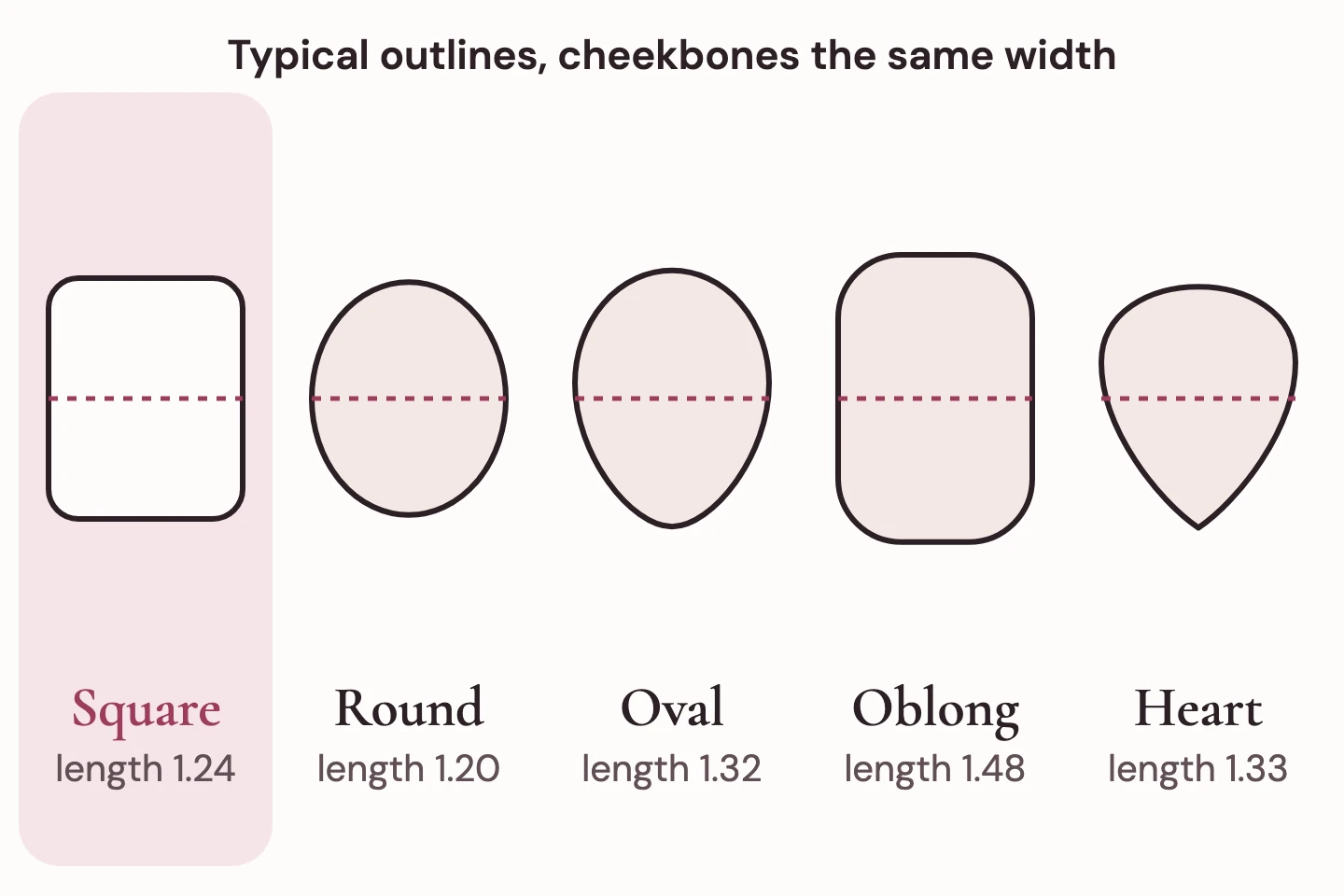
Read them. A typical square face measures about 1.24 for length, with the forehead near 0.94 and the jaw near 0.96 of the cheekbone width. A similar length with a clearly narrower jaw leans round instead.
Feel your jaw. Start under your earlobe and trace forward along the bone. A distinct corner says square. One smooth curve says round, whatever the numbers show.
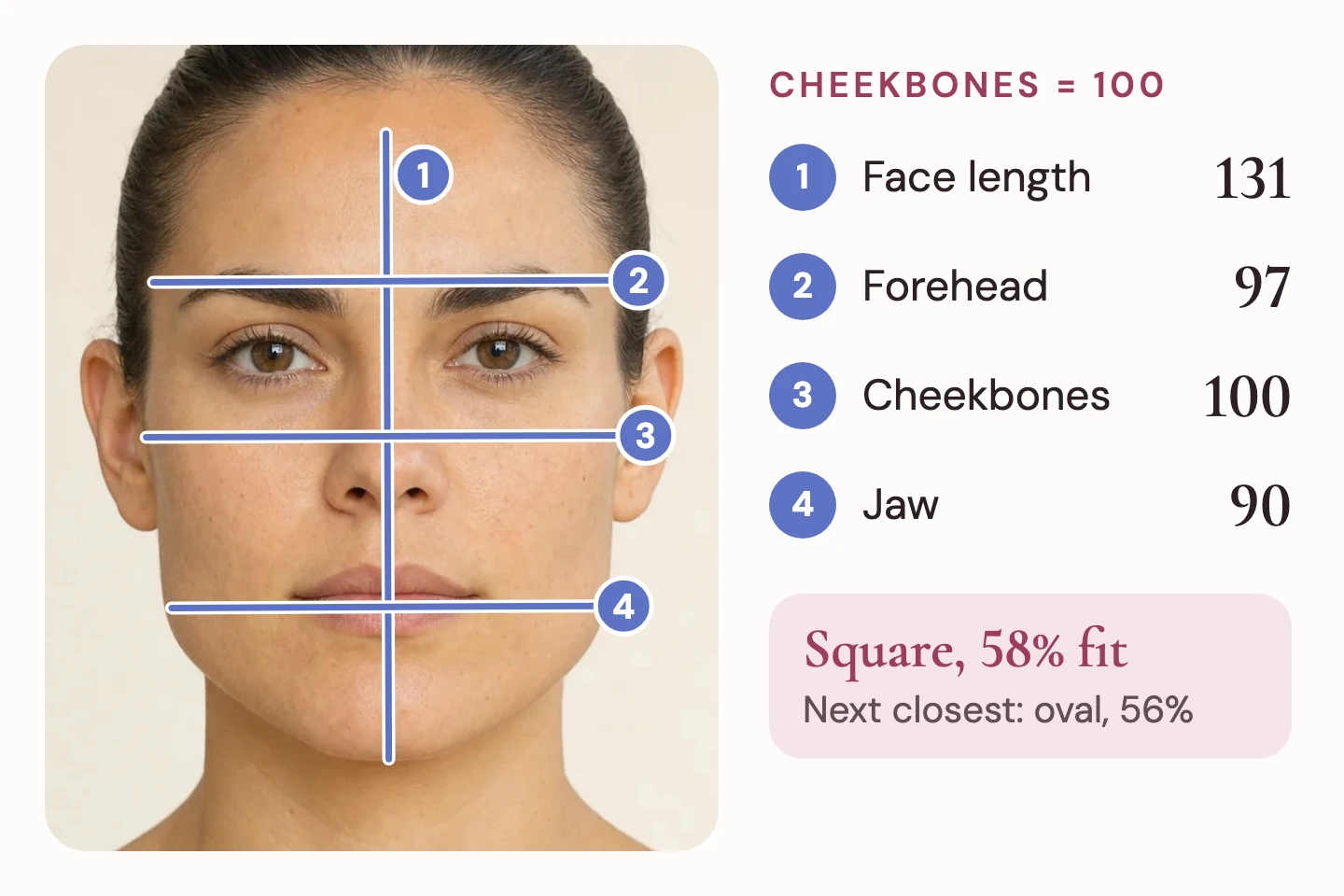
Here is one face worked through, with example measurements:
| Step | Result |
|---|---|
| Forehead, cheekbones, jaw | 13.6, 14.0 and 13.4 cm |
| Length | 17.5 cm |
| Length ÷ cheekbones | 17.5 ÷ 14.0 = 1.25 |
| Forehead and jaw ÷ cheekbones | 0.97 and 0.96 |
| Reading | Square at an 87% fit in the calculator, so check the jaw corners |
Three mistakes push these numbers off more than any others:
- Measuring the jaw too far forward. Take it at the angle below the ears. Closer to the chin, every jaw looks narrow.
- A tilted camera. A phone held above the eyes shrinks the jaw and stretches the forehead, and one held below does the reverse. Keep it level, an arm and a half away. The photo rules cover the rest.
- A clenched jaw. Tensing the chewing muscle widens the lower face, so let your teeth rest apart.
If you would rather skip the ruler, the free face shape calculator reads the same four lines from 478 points on your photo, or takes four numbers you type. The photo is measured on your device and is not uploaded.
From a photo, the calculator also reads how sharply your jaw turns, the one thing that separates square from round. Typed numbers can't carry that corner, and a photo has to estimate your hairline, so a close call gets a next closest shape beside the result. Round or triangle showing up there is normal for a square face, and feeling your jaw settles the rest.
Square vs round, oval, oblong and heart
Most wrong answers come from the neighbouring shapes, and the differences are small enough to see side by side.
| Comparison | How to tell them apart |
|---|---|
| Round vs square face | Width and length can match. A round face curves through the jaw, and a square one turns a corner. |
| Oval face shape vs square | An oval is longer, about 1.32 times the cheekbones, and narrows gently at the chin. |
| Oblong or rectangle | The same even widths on a longer face, about 1.48 times the cheekbones. |
| Square vs heart face shape | A heart has a forehead about 1.25 times the jaw and tapers to the chin. A square keeps both level. |
| Diamond | The cheekbones stand out, with forehead and jaw both well inside them. |
| Triangle | The jaw is the wide end, with the forehead about 0.92 times its width. |
The calculator has no separate rectangle. A long face with even widths reads as oval until its length passes about 1.4 times the cheekbones, then as oblong, even with strong corners. So a chart may call you rectangle while the calculator says oval or oblong. Neither is wrong: they draw the line in different places.
Soft square, squoval and other in-between faces
Plenty of faces sit between categories, and that is a normal result, not a failed test. A soft square has square proportions with rounded corners. A round square face is the same idea seen from the other side. Squoval face shape, a word better known from nails, means a length nearer an oval's with a square's corners.
If you are stuck on oval or soft square face, compare length first. Under about 1.28 times the cheekbones, you lean square or round. Above it, you lean oval. Then style for what you notice most: strong corners take the square advice below, and a softer jaw can borrow from oval or round.
Square face shape hairstyles that soften the corners
The best square face shape hairstyles do one of two things: they break the straight line at the jaw, or they add height and length so the width reads less. None of this is compulsory. A strong jaw is a feature, and these are style conventions, not rules. If you want a softer look, four moves do most of the work:
- Keep the ends off the jawline. Stop well above it or well below it.
- Start layers at the chin or lower. They curve around the corners instead of sitting on them.
- Choose a side part. It adds a diagonal to a face built from straight lines.
- Add texture. Waves and curls break up an even outline.
Hairstyles for women
A good hairstyle for a square face usually starts with movement around the jaw. These hairstyles for square faces all come from the cut library behind the FaceStats report:
| Cut | Why it works |
|---|---|
| Long layers | Length past the shoulders, with layers from the chin down. |
| Soft medium layers | Collarbone length with pieces that frame the face. |
| Long bob | The ends sit between chin and collarbone, clear of the jaw. |
| Wavy textured bob | Built-in waves soften the angles. |
| Side-swept fringe with layers | A long fringe crosses the corners of the forehead, as curtain bangs do. |
| Modern shag | Layers and crown volume add height and movement. |
Any square face hairstyle can carry a hard line if you want drama. The cuts most likely to stress the corners are blunt bobs that stop at the chin and heavy straight fringes. Whichever haircut for a square face you choose, match it to your hair type too: a shag needs some body, and fine hair may hold a long bob better.
Square face shape men: haircuts and beards
Most advice for square face men runs the other way: the angle is the asset, so the job is to frame it rather than hide it. A good men's haircut for a square face keeps the sides neat and puts the interest on top:
- Textured crop: short sides with a lightly textured top.
- Modern quiff: volume at the front adds height above a wide jaw.
- Neat push-back: medium length off the face, relaxed and open.
- Slick back: shows the whole outline, so it suits a strong one.
- Buzz cut: no styling at all, which lets the bone structure do the work.
- Low fade with curls on top: keeps the shape without fighting the texture.
Beards follow the same logic. Stubble or a short, even beard keeps the jawline clean. Bulk at the corners widens the lower face, while a little more length at the chin adds height.
For every other shape, see the face shape and hairstyle guide. The sample report shows what the paid report does with this: six haircuts previewed on one photo.
Glasses and sunglasses for a square face
The rule for glasses for a square face is contrast: curves against corners. What type of glasses for a square face works best? Round, oval or soft cat-eye frames, which draw the eye up and away from the jaw. If you want one answer for the best glasses shape for a square face, start with a soft oval.
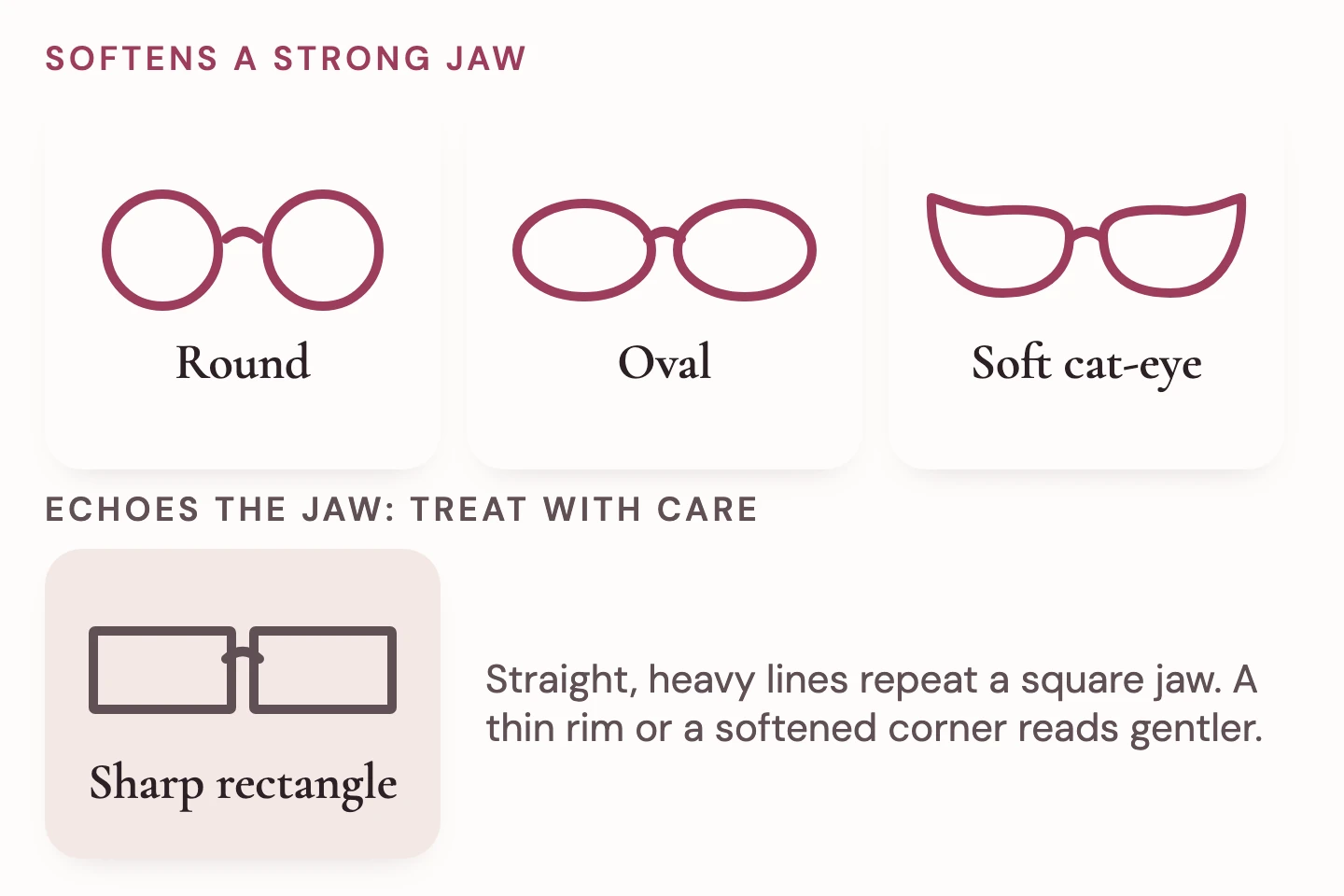
For sunglasses for a square face, round, aviator and soft oversized shapes do the same job at a larger size. Sharp rectangles are the one style to treat with care, since they echo the jawline.
Fit counts as much as shape. Square face shape glasses should be about as wide as your face at the cheekbones, with no gap at the temples and no overhang. A thin rim also reads softer than a heavy one, so a bold shape can still work in a lighter frame.
Square face makeup
Square face makeup uses light and shadow to round the corners a little. It is optional, and many people prefer to keep the angles. If you want the softer version, these four steps cover it:
- Contour: place a matte shade just under the jaw corners and at the temples, then blend until no line shows.
- Square face blush: start on the apples of the cheeks and sweep up towards the temples, which lifts attention off the jaw.
- Highlight: keep it to the centre of the forehead, the tops of the cheekbones and the chin.
- Brows: a soft arch curves against the straight lines, while a flat, heavy brow repeats them.
Is a square face shape attractive?
It can be, and so can every other shape: no outline is more attractive on its own. Strong jawlines are a familiar sight in fashion and film, on women as well as men. Are square jaws on women attractive? Some people find them striking and others prefer softer lines, and that difference is taste, not a measurement. Square jaw women are often told to soften the look, but that is one styling choice, never a correction.
A face score can only say so much here. The FaceStats balance score does not use the shape label at all. One of its four parts, though, compares visible face length with cheekbone width against a reference of 1.38 and counts for 15% of the overall score, so a shorter, wider face gets a lower mark on that single line. That reflects where the reference sits. It says nothing about how you look to the people around you, and no score measures your worth.
Square face shape FAQ
Is a square face shape rare?
No reliable count exists. Exact percentages you see online rarely cite a study, and charts draw the lines between shapes in different places. Many faces sit between square and round or square and oval, so a pure square may be less common than the in-between versions, but nobody has measured that well.
Do square faces look better with long or short hair?
Both work. Long hair with layers from the chin down adds length and movement, while short styles work when they add height or texture on top. The length to watch is a blunt cut ending right at the jaw, because it draws a straight line across the widest part of the lower face.
What hairstyles should a square face avoid?
Nothing is forbidden, but a few cuts stress the corners: blunt one-length bobs that stop at the chin, heavy straight fringes and flat, severe parts with no layers. If you like a strong line, these can still look deliberate. For a softer result, move the length away from the jaw and add texture.
Can a square face shape change?
Bone structure stays largely the same, though weight and age can soften or sharpen the outline. Nothing needs correcting, but people asking how to fix a square face shape often mean a wide jaw. Injections that relax the masseter muscle narrow it for a while. That is a medical decision for a qualified doctor.
Is a square head shape the same as a square face?
Not quite. A square face describes the front outline: forehead, cheekbones, jaw and length. A square head shape usually refers to the whole skull, including the top and sides, and comes up most with very short haircuts. The two often appear together, but either one can exist without the other.
Which celebrities have a square face shape?
Style lists often name Angelina Jolie, Olivia Wilde and Henry Cavill among people with a square face shape, but those lists disagree with each other, and lighting, angle and hair change how any face reads. Treat a famous name as a loose reference, then measure your own face instead.
Are the rules different for men and women?
No. The calculator compares every face with the same seven shapes, because the same four widths and length describe any outline. What changes is the styling: men often frame the jaw with neat sides and a beard, while women more often soften it with layers. Either choice works for either person.
Check your square face shape
You now have both tests: the numbers and your jaw. To skip the ruler, check your square face shape with the free calculator. It reads your photo on your device with no sign-up, names the closest of seven shapes and adds a short styling note. Then feel your jaw corners to settle anything it leaves close.